Ghosting: psykologien bak å forsvinne uten forklaring
Onedayte Redaksjonen
Ekspert hos Onedayte
You had three great dates. The conversation flowed, there was chemistry, you were already making plans for the fourth date. And then: silence. No message, no explanation, no closure. You send another text. Nothing. You check social media and see that he or she is perfectly active. Just not for you. You've been ghosted.
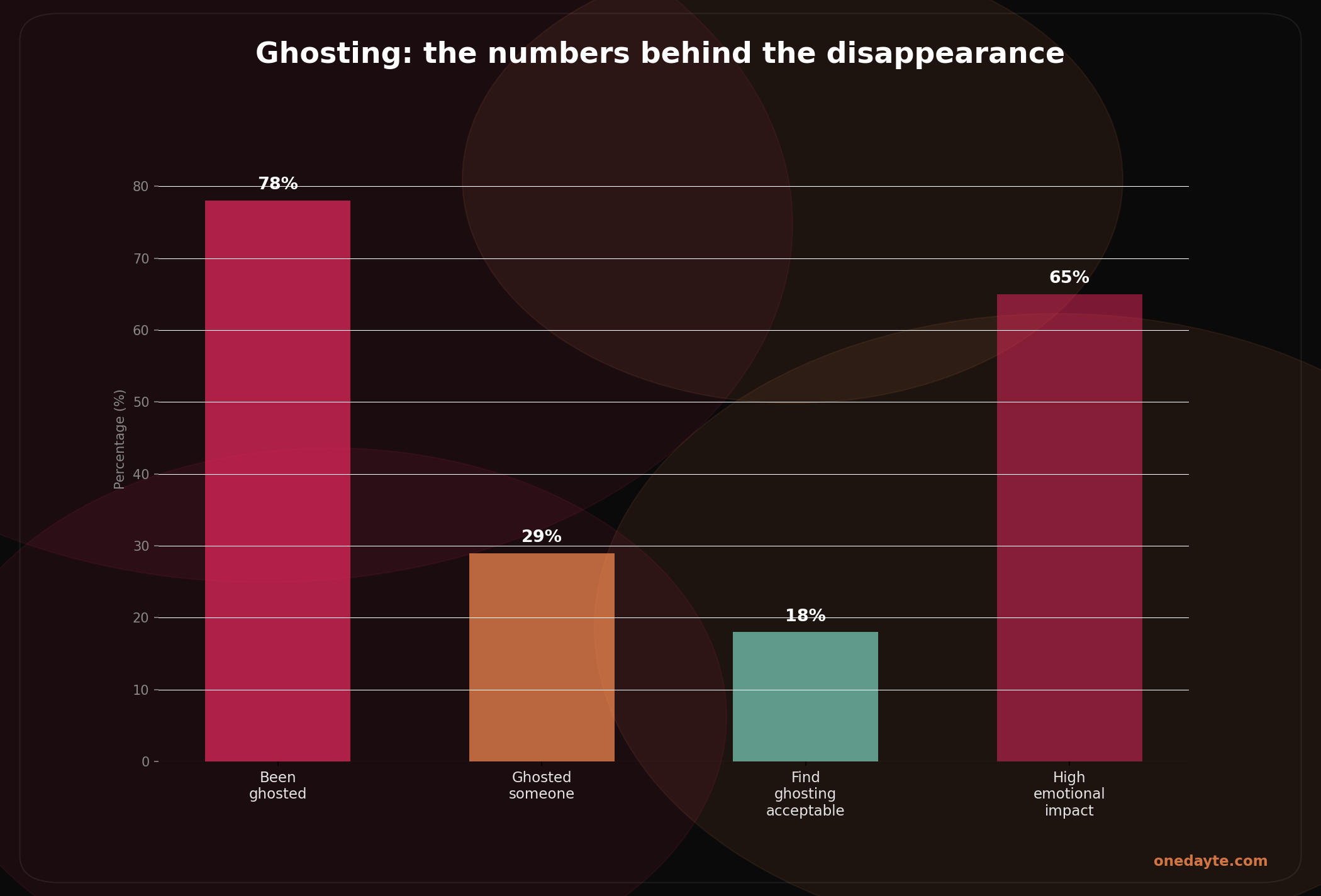
Research by Timmermans and Opree (2019), conducted at the Universitetet i Oslo among norske og skandinaviske dating-app users, shows that 85 prosent have been ghosted at some point. 63 prosent admit to having ghosted someone themselves. It's not an exception. It has become the norm in modern dating culture.
Hva er ghosting and why do people do it?
Ghosting is the abrupt termination of all communication with someone without explanation. It differs from a gradual fading of contact because it is sudden: one moment there is contact, the next moment complete silence.
A variant that is becoming increasingly common is slow ghosting: the gradual reduction of contact without explicit closure. The messages become shorter, the response time longer, the excuses more frequent. The effect is perhaps even more painful than abrupt ghosting, because it prolongs the uncertainty. You don't know whether the contact is dying out or whether you're imagining things.
Psychologists identify three main reasons. The first is conflict avoidance: the conversation in which you honestly say you're no longer interested is uncomfortable. Ghosting bypasses that discomfort entirely. The second is emotional immaturity: lacking the skill or willingness to communicate difficult feelings. The third is the disposability that dating-apps create: if there's always a next profile, it feels less necessary to close things properly with the current one.
Viktig insight: ghosting almost always says more about the ghoster than about the person being ghosted. It is a coping strategy for someone who struggles with confrontation, not a judgement about your worth.
Research from KU Leuven confirms that communication overload on dating-apps increases the likelihood of ghosting. Anyone simultaneously in conversation with five or ten matcher experiences decision fatigue. And the easiest way to reduce that overload is simply to stop responding to the conversations that feel lowest priority.
Den psykologiske påvirkningen av å bli ghostet
Research summarised by the American Psychological Association shows that social rejection activates the same brain regions as physical pain. With ghosting, the effect is amplified because there is no closure. Your brain keeps searching for an explanation that never comes, leading to rumination, self-blame and declining self-confidence.
"Rejection sensitivity is a cognitive-affective processing disposition that develops from early experiences of rejection."
— Downey & Feldman, Journal of Personality and Social Psychology, 1996
Ghosting can also reinforce tilknytningsmønsters. Engstelig tilknyttede people become more anxious: their deepest fear (abandonment) is confirmed. Unnvikende tilknyttede people use it as evidence that connection cannot be trusted. In both cases, ghosting reinforces precisely the pattern that was already problematic.
Ghosting og tilknytningsstil: en direkte kobling
There is a demonstrable link between tilknytningsstil and ghosting behaviour. Unnvikende tilknyttede people ghost more often, because avoiding difficult conversations fits their primary coping strategy: deactivation. Not having the conversation is the path of least resistance for them. Engstelig tilknyttede people are hit harder by ghosting, because it activates their deepest fear in a situation where they have no control whatsoever.
This link makes ghosting not just a dating problem, but an attachment problem. And that is precisely why matching on tilknytningsstil and emosjonell tilgjengelighet can reduce ghosting. Anyone matched with someone who is emosjonelt tilgjengelig and communicative has a fundamentally lower chance of being ghosted.
Sources: LeFebvre (2017), Freedman et al. (2019)