Reparasjonsforsøk: den mest undervurderte ferdigheten i et forhold
Onedayte Redaksjonen
Ekspert hos Onedayte

67 prosent of all forhold conflicts are unsolvable. That sounds alarming, but it's actually liberating. Because it means that forskjellen between a happy and an unhappy forhold isn't the absence of conflict. It's how you deal with conflict. And the most viktig skill in that has a name: reparasjonsforsøk.
"A reparasjonsforsøk is any statement or action that prevents negativity from escalating out of control."
— Gottman & DeClaire, The Forhold Cure, 2001
John Gottman discovered in his Love Lab that this single concept is the strongest predictor of whether a forhold will last. Stronger than the frequency of arguments, stronger than the topics you disagree about, stronger than the personalities of the partners. The ability to break through tension in the middle of a conflict is the secret superpower of happy par.
Hva er reparasjonsforsøk?
A reparasjonsforsøk is any action, remark, or gesture that reduces tension during or after a conflict. It can be a joke at exactly the right moment. A hand on your partner's arm while you disagree. The words 'I understand you're angry, and I want to understand why.' Or simply the suggestion to take a break and continue talking later.
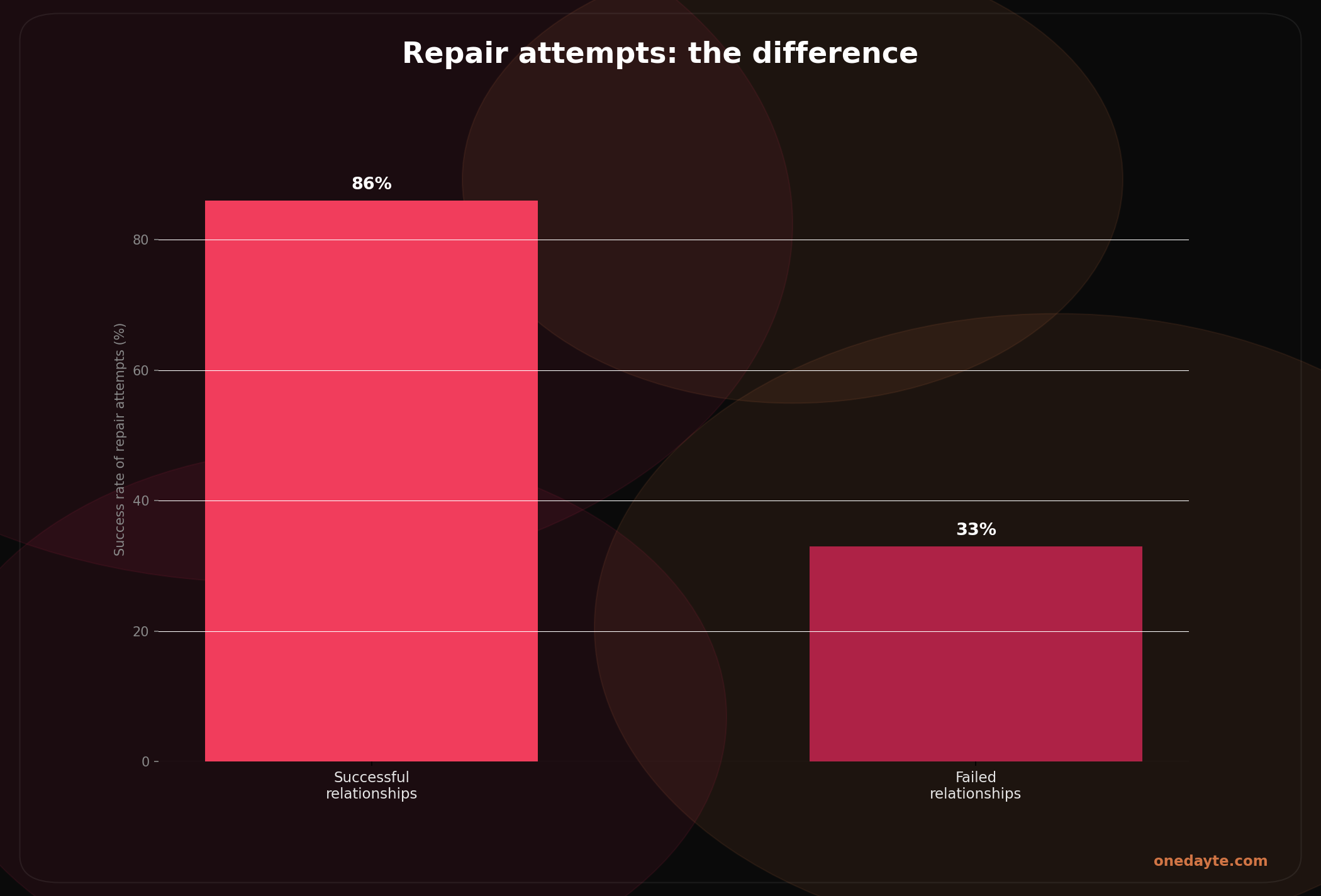
Gottman oppdaget at the presence of successful reparasjonsforsøk is the strongest predictor of whether a conflict strengthens or weakens a forhold. Not the severity of the argument, not the topic, not the raised voices. It's the ability to bring de-escalation that makes forskjellen.
The word 'successful' is crucial here. A reparasjonsforsøk only works if the partner recognises and accepts it. In happy forholds, reparasjonsforsøk are more often noticed and accepted — even clumsy ones. In unhappy forholds, even well-intentioned attempts are ignored or rejected.
Hvorfor reparasjonsforsøk er viktigere enn å aldri krangle
Couples who never argue aren't necessarily happier. They often avoid conflict out of fear or avoidant attachment, which leads to emotional distance and unspoken frustrations that slowly erode the connection. Couples who do argue but deploy effective reparasjonsforsøk actually have stronger forholds. The argument becomes a moment of deepening instead of distancing.
One of Gottman's most cited discoveries is about the first three minutes. A conflict conversation that begins with a gentle start — what he calls a myk oppstart ('I notice I feel stressed when...' instead of 'You always...') — leads to a constructive conversation with 96 prosent accuracy. The first three minutes determine the outcome, regardless of how long the conversation lasts.
Hvordan gjenkjenne og gjøre et reparasjonsforsøk
Reparasjonsforsøk come in many forms. Humour is one of the most powerful: laughing together about the absurdity of an argument breaks the tension immediately. 'Wait, are we really going to argue about the dishes?' can completely change the tone of a conversation.
Other forms: taking responsibility for your part ('You're right, I should have handled it differently'). Showing empathy ('I understand you feel ignored'). Making a meta-comment ('I notice we're both angry. Can we start over?'). Seeking physical contact (a hand on the shoulder, a hug in the middle of an argument).
Gottman's 20-minute protocol is for moments when things escalate and one partner experiences emotional flooding. When your heart rate goes above 100 beats per minute, constructive communication is biologically impossible. Take a break of minst 20 minutes. Say explicitly: 'I notice I'm becoming overstimulated. I want to take a break and then continue talking.' The agreement is: you come back. Not staying away, not letting the conversation die, but coming back with a gentle restart.
Onedaytes konfliktverktøy
In Phase 7 (forhold maintenance), Onedayte offers a structured repair conversation when a par indicates they're having a conflict. It contains four steps: selvberoligning (the 20-minute protocol), a myk oppstart template ('I feel [emotion] when [specific behaviour] because [need]'), reparasjonsforsøk suggestions from a personalised list, and a joint action plan. Not a replacement for par therapy, but a practical tool for daily use.
Source: Gottman Institute