Være sårbar under dating: hvordan bygge en ekte forbindelse
Onedayte Redaksjonen
Ekspert hos Onedayte

You're on a date and the conversation is going fine. Work, holidays, TV show recommendations. All safe. But you feel something is missing. There's no real connection. Not because the other person is unkind, but because neither of you is showing anything of yourself that truly matters. You're talking about the outside of your lives while the inside remains unspoken.
Vulnerability is the key to real connection. And it is precisely what most daters actively avoid. Not because they don't want to, but because it's scary. Showing yourself as you truly are, including insecurities and imperfections, feels like a risk. But it is a risk that almost always pays off.
Hvorfor sårbarhet føles skremmende men er nødvendig
Researcher Brene Brown showed in her TED Talk (the fourth most watched ever, with more than 60 million views) that vulnerability is not weakness, but the birthplace of connection, creativity and love. Her research at the University of Houston shows that people who are willing to be vulnerable experience deeper forholds, build more trust and are ultimately happier.
"Vulnerability is the birthplace of love, belonging, joy, courage, empathy and creativity."
— Brené Brown, Daring Greatly, 2012
In a dating context, this means: as long as you only show your best side, your date can only love that curated image. It feels safe, but it is an illusion. Real connection arises when you share something that isn't polished. An insecurity, a dream you haven't yet spoken aloud, a memory that moves you. Only at that moment can the other person decide to love you, not your image.
The paradox is that most people actually find vulnerability in others attractive. When your date shares something personal, you feel warmth and connection. But when it comes to your own vulnerability, it feels like a risk. That asymmetry is universal and explains why most første dates remain superficial: everyone waits for the other to begin.
Sårbarhet i praksis: dosering og oppbygging
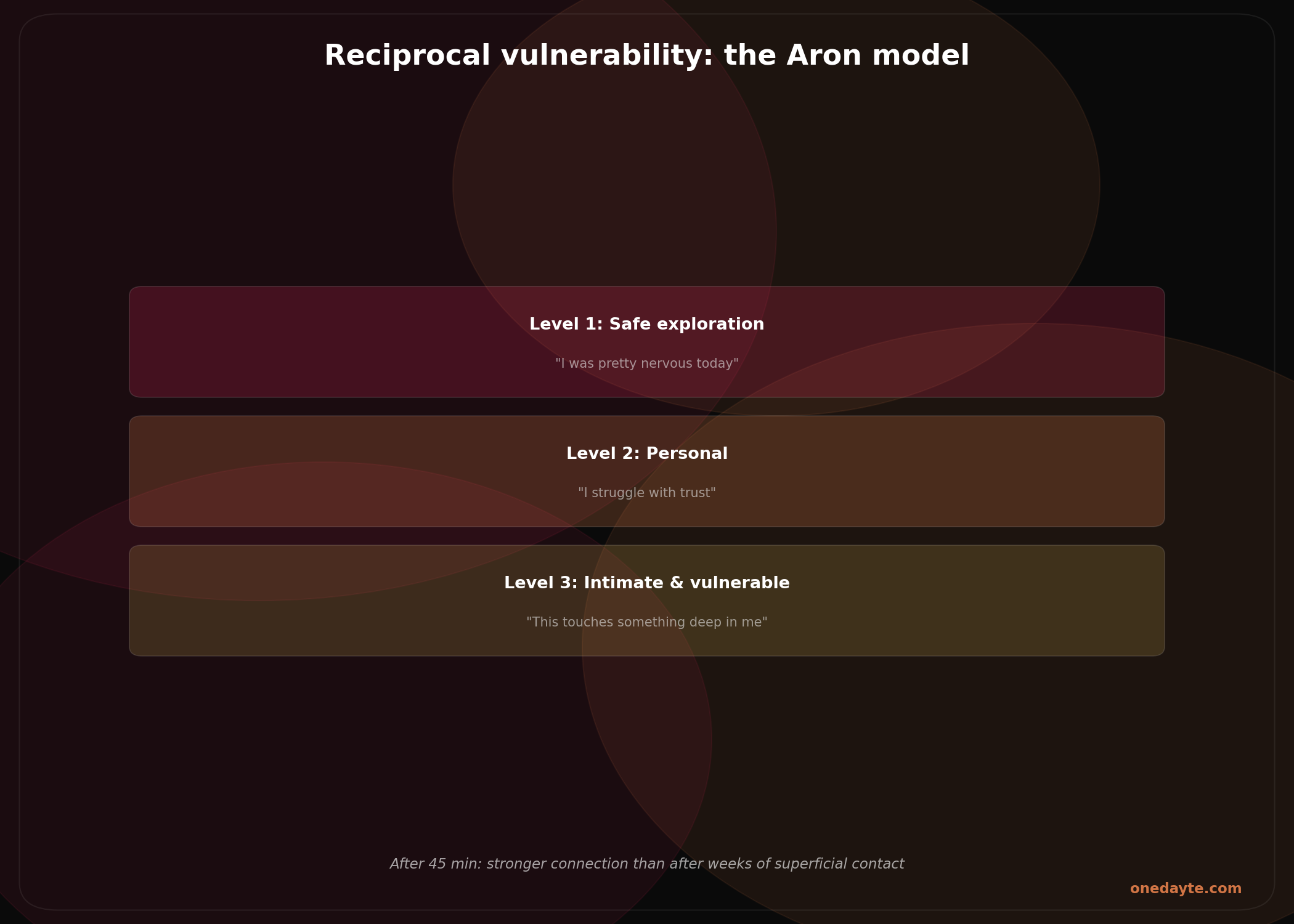
Being vulnerable is not the same as sharing everything. It's about dosing. On a første date, you don't need to tell your entire life story, discuss your deepest trauma or lay bare your greatest fears. Start with something small but personal. 'I was quite nervous about today.' 'I struggle with small talk, but I'm glad to be here.' 'I don't really know what I'm looking for, but I wanted to find out.'
The art is then to respond to vulnerability with vulnerability. When your date shares something personal, respond with empathy and share something back. That is the essence of what John Gottman calls vende seg mot: every emotional signal from the other person is an invitation to connect. If you respond with attention and openness, the connection grows. If you respond with distance or superficiality, the conversation dies.
Psychologist Arthur Aron proved this in his research. He sat two strangers across from each other and had them answer gradually more personal questions. After 45 minutes, the emotional connection was stronger than with par who had been chatting superficially for weeks. The key was not spørsmålets themselves, but the reciprocal vulnerability they facilitated.
"One key pattern associated with the development of a close forhold among peers is sustained, escalating, reciprocal, personal selvutlevering."
— Aron et al., Personality and Social Psychology Bulletin, 1997
Fallgruven med overdeling
There is a difference between vulnerability and oversharing. Vulnerability is sharing something personal at the right moment, in the right context, with the right dosage. Oversharing is pouring out your entire life story to someone you've just met, without regard for how it lands.
Oversharing on a første date can put the other person off. Not because vulnerability is repulsive, but because the balance is missing. If after ten minutes you're discussing your divorce, your therapy sessions and your forhold with your parents while the other person is still working out what to drink, you create an inequality that feels uncomfortable.
The rule of thumb: share something small, see how the other person responds, and build from there. Vulnerability works best when it is gradual and reciprocal. Exactly the principle on which Onedayte's Guided Connection is built.
Hvordan Onedayte legger til rette for sårbarhet
The Doktorsamtalen in Phase 3 is designed based on EFT principles: from safe to vulnerable. The opening is light and inviting. Spørsmålets gradually become more personal. The AI responds to your answers with empathy and follow-up questions, creating the experience of a real conversation rather than a questionnaire.
The Guided Connection in Phase 6 applies the same principle between two matcher. Both partners receive the same questions: 'Hva er something few people know about you, but that you would like to share?' 'What do you value most in your best friend?' Those questions are designed to open the door to vulnerability without forcing it. Resultatet is a first interaction that goes deeper than any opening line ever could.
Source: Aron et al. (1997)