Tilknytningsstil og dating: hvordan mønsteret ditt bestemmer matchene dine
Onedayte Redaksjonen
Ekspert hos Onedayte

Have you ever wondered why you keep falling for the same type of partner? Or why that one forhold that started so well still ended in exactly the same way as the previous one? Svaret probably lies in your tilknytningsstil: a pattern that forms in your early childhood and that, like a kind of relational compass, determines how you behave in love.
What most people don't know is that the same tilknytningsstil also drives your behaviour on dating-apps. From how often you check the app to who attracts you and why you drop out after three dates. Psychologists Hazan and Shaver already showed that adult romantic forholds display the same tilknytningsdynamikks as the bond between child and parent.
Hvordan tilknytningsstilen påvirker sveipeatferden din
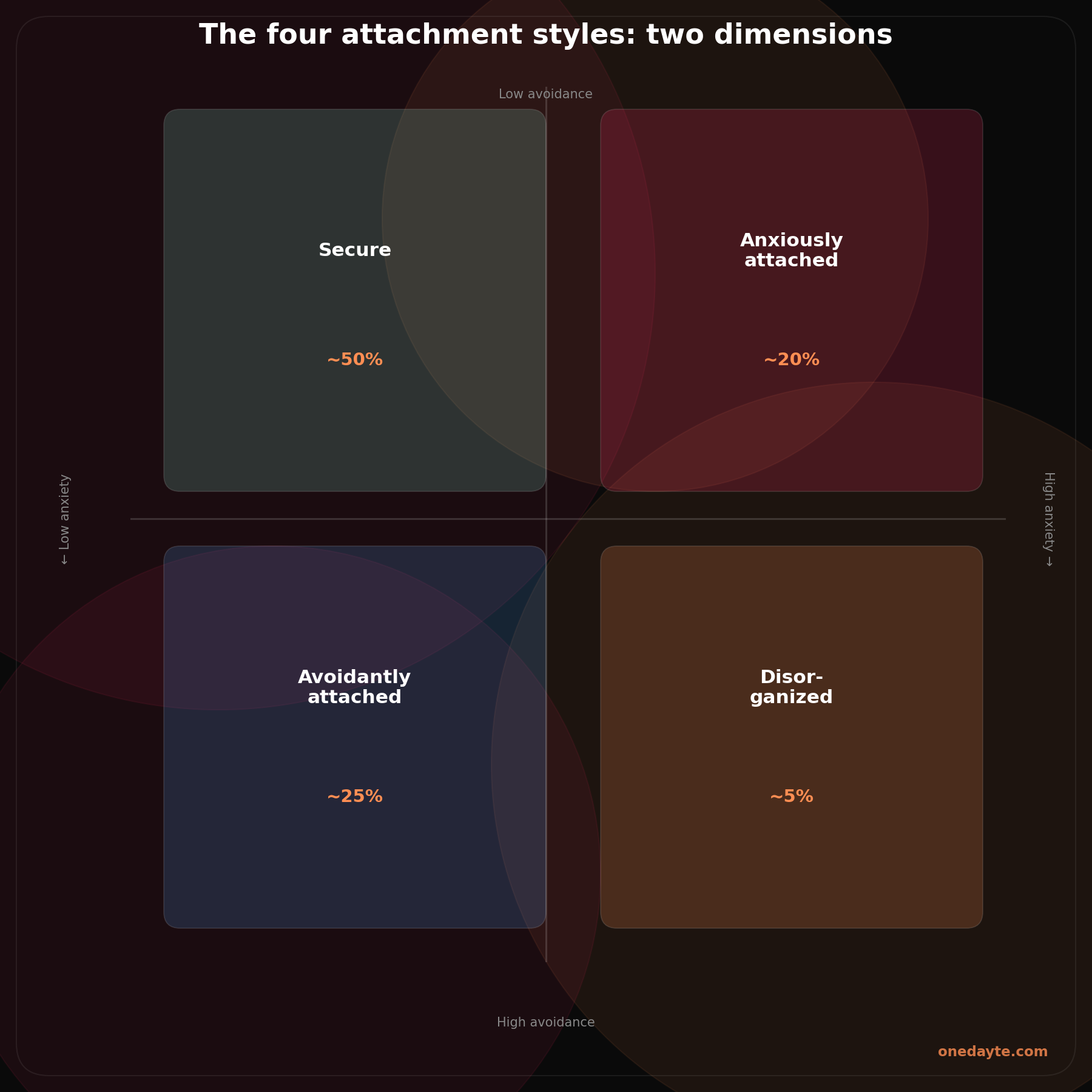
Trygt tilknyttede daters sveip more calmly. They feel less urgency, take time to read profiles, and don't immediately feel rejected if a match doesn't respond. They approach dating with a basic trust that things will work out.
Engstelig tilknyttede daters check the app obsessively. They feel a constant need for validation through matcher and become restless when a conversation goes quiet for a moment. A blue tick without a reply can set off a spiral of rumination that is completely detached from reality.
Unnvikende tilknyttede daters use the app superficially. They sveip a lot but invest little in conversations. As soon as things start to get serious, they pull away or start finding faults in the other person. The app is a way for them to keep the idea of dating alive without confronting real intimacy.
Engstelig-unnvikende daters swing between both extremes. One day they sveip enthusiastically and invest in conversations, the next day they delete the app and withdraw completely. That inconsistency makes it difficult for both themselves and their matcher to build a stable connection.
Hvorfor standard matching bommer
A profile doesn't show how someone responds to intimacy, conflict or distance. It doesn't show whether someone is emosjonelt tilgjengelig or deploys deaktiverende strategier as soon as things get intense. Those patterns only become visible through targeted questions and scenarios that reveal actual behaviour, not through a bio or a photo.
No traditional dating platform measures this. Parship measures personality types. Hinge measures preferences. Tinder measures physical attractiveness. But none of them measure how someone behaves when the forhold becomes serious.
Hvordan Onedayte matcher på tilknytningsstil
Onedayte's Attachment Scan consists of 12 scenario questions that measure two continuous dimensions: anxiety (fear of abandonment) and avoidance (discomfort with intimacy). No abstract statements ('I feel comfortable with intimacy'), but concrete situations: 'Your partner hasn't responded to your message. It's now 3 hours later. What do you do?'
Based on those scores, a 4x4 compatibility matrix is applied. The most destructive combinations (particularly anxious combined with avoidant) are filtered out, unless one of the partners displays sufficient secure tendencies to stabilise the dynamic. Resultatet: matcher that don't just start well, but that have a real chance of a stable forhold.
A frequently asked question is whether it is fair to filter based on tilknytningsstil. Svaret is nuanced. Onedayte excludes no one. The system seeks the best-fitting matcher for each user, taking into account their specific tilknytningsprofil. An engstelig tilknyttet person is not matched with fewer people, but with different people: partners who offer the safety needed for a healthy forhold.
Forskningen by Hazan and Shaver (1987) laid the foundation for this insight: adult romantic forholds display the same tilknytningsdynamikks as the bond between child and parent. Anyone who understands this also understands why a dating-app that ignores tilknytningsstil is missing a fundamental piece of the puzzle. It is like building a house without checking the foundation. It may look beautiful, but at the first storm you'll know whether it holds up.
Sources: Mickelson et al. (1997), Hazan & Shaver (1987)