Verdier i et forhold: hvorfor de betyr mer enn felles hobbyer
Onedayte Redaksjonen
Ekspert hos Onedayte

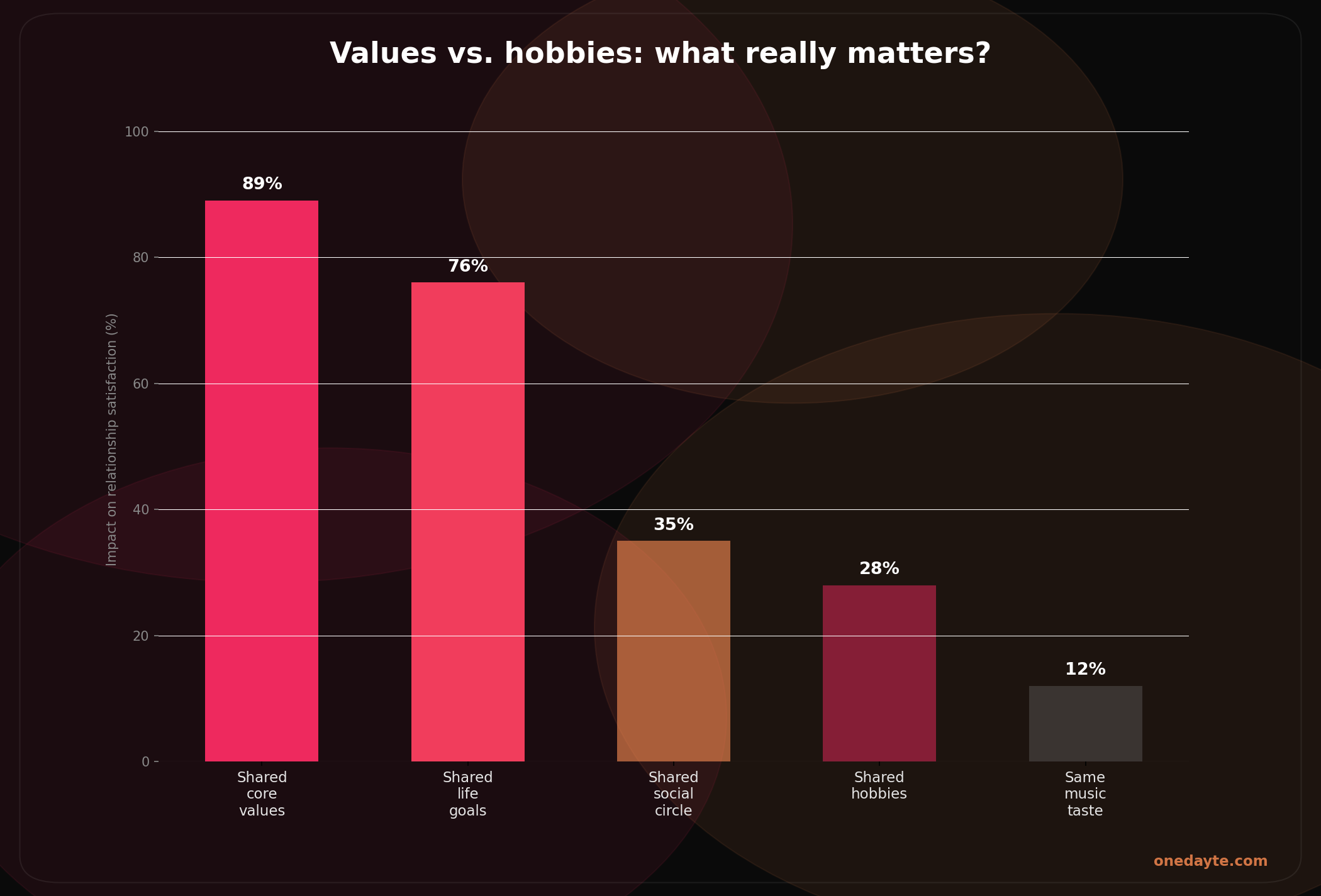
You both love hiking, Italian food and the same Netflix series. Yet the forhold stalls. After a year you notice that you think fundamentally differently about how to handle money, how viktig family is, and how much freedom you need. The hobbies were fun for the første dates, but they turned out to say nothing about whether you could build a life together.
That is forskjellen between interests and values. And it is a difference that most dating-apps completely ignore.
Hva er verdier i en relasjonskontekst?
Values are your fundamental beliefs about what matters in life. Not your hobbies, but your compass. Psychologist Shalom Schwartz identified in his influential research (1992, publisert i Advances in Experimental Social Psychology) a universal value system that transcends cultures. People all over the world organise their lives around the same basic values, but the ranking differs from person to person.
In a forhold context, this concerns values such as loyalty, honesty, adventure, stability, family, ambition, freedom, humour, intimacy, growth, spirituality, creativity, safety, equality and community. Two people can share the same hobby but have entirely different values. And that difference only becomes visible when choices have to be made: do we move for your career? How do we divide our money? How often do we see your parents?
Hvorfor felles verdier gjør forhold sterkere
Gottman calls shared values a component of felles mening: the shared life narrative that par build together. Couples who agree on fundamental values have significantly less conflict about the day-to-day shape of their lives. Not because they always agree, but because they navigate from the same compass.
Viktigly: it is not about identical values, but about compatible values. Two people who both value freedom highly but express it differently (one through solo travel, the other through creative projects) can function excellently together. They understand each other's needs, even when the form differs. Two people where one seeks stability and the other constant adventure more often get stuck. Not because one is right and the other is wrong, but because their compasses point in opposite directions.
Forskjellen becomes visible in daily choices. How do we spend the weekend? How do we deal with unexpected expenses? How much time do we invest in family versus personal projects? Those choices are the translation of values into behaviour.
Research also confirms that shared values are more stable than shared interests. Your hobbies change over the years: you stop running, you start doing yoga, you discover a new passion. But your core values shift much more slowly. Someone who places loyalty and honesty at the top at twenty probably still does so at fifty. That makes values a more reliable foundation for a long-term forhold than any hobby.
Hvordan Onedayte måler verdier
In the Match Boosters, Onedayte includes a Verdirangering: users rank 15 values from most to least viktig. That relative position is more informative than a simple top 3, because it shows how values relate to each other. Someone who puts loyalty at 1 and adventure at 15 lives fundamentally differently from someone who puts adventure at 1 and loyalty at 3, even though they both rank loyalty highly.
Two users who have loyalty, honesty and safety at the top share a fundamental value system that research associates with strong long-term forholds. That says more about their compatibility than the fact that they both love sushi.
Sources: Luo & Klohnen (2005), Finkel (2017)