36 questions to fall in love: Arthur Aron's experiment
Onedayte Redactie
Expert at Onedayte

In 1997, psychologist Arthur Aron and colleagues published a study that would later go around the world. It appeared in the Personality and Social Psychology Bulletin and the setup was deceptively simple: seat two strangers facing each other, have them answer 36 questions that gradually become more personal, and see what happens. The result was remarkable: after 45 minutes, the participants experienced a sense of connection that was stronger than couples who had been chatting superficially for weeks. One of the couples from the experiment got married six months later.
The study made worldwide news again in 2015 when essayist Mandy Len Catron wrote about it in The New York Times. Her article 'To Fall in Love with Anyone, Do This' went viral and turned the 36 questions into a cultural phenomenon. But behind the hype lies serious science that is directly relevant to how we date.
How the experiment works
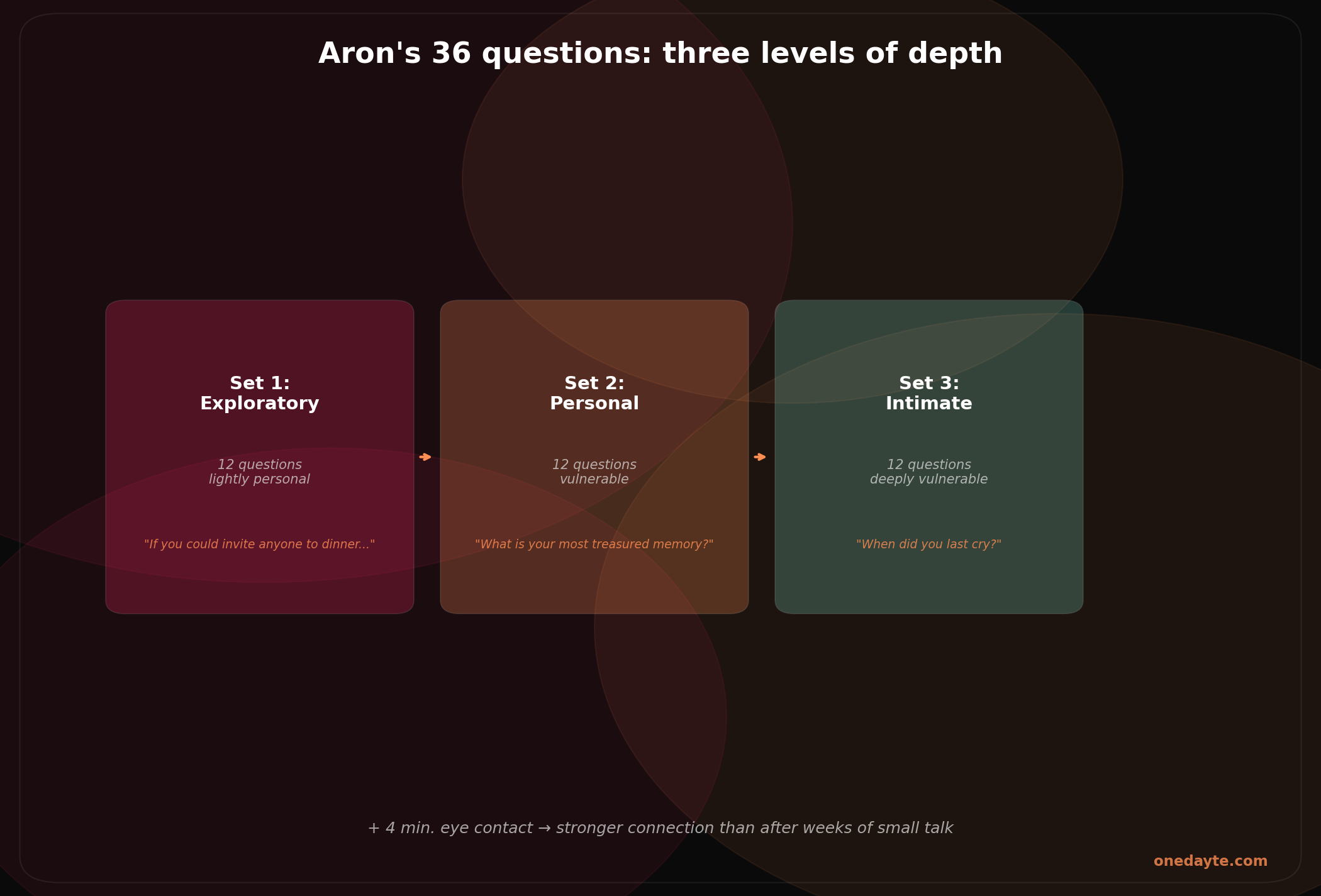
The 36 questions are divided into three sets of 12. Each set goes a layer deeper. Set 1 is lightly personal and exploratory: 'If you could invite anyone in the world to dinner, who would it be?' 'Would you like to be famous? In what way?' 'When did you last sing to yourself? And to someone else?' The questions are designed to spark curiosity without being confrontational.
Set 2 becomes more vulnerable and personal: 'What is your most treasured memory?' 'What is your most terrible memory?' 'If you knew that in one year you would die suddenly, would you change anything about the way you are now living? Why?' Here the conversation shifts from factual to emotional. The questions force you to think about what really matters in your life.
Set 3 is intimate and vulnerable: 'When did you last cry in front of another person? And alone?' 'Tell your conversation partner something that you already like about him or her.' 'Share a personal problem and ask your conversation partner for advice.' The final questions break the social convention that on a first meeting you only show your best side.
After the 36 questions comes the final part: four minutes of eye contact in silence. No words, no distractions, just each other's gaze. Participants often describe this as the most intense part. It is the moment when the connection that the questions have built becomes physically tangible.
Why it works: the science of reciprocal self-disclosure
"One key pattern associated with the development of a close relationship among peers is sustained, escalating, reciprocal, personal self-disclosure."
— Aron et al., Personality and Social Psychology Bulletin, 1997
The mechanism behind the 36 questions is called reciprocal self-disclosure: gradually increasing vulnerability that is shared by both parties. It is not a trick or manipulation. It is the accelerated version of how human connection naturally works.
In a normal getting-to-know-you process, it takes weeks or months for two people to reach the same depth. The 36 questions compress that process into 45 minutes. Not by taking shortcuts, but by removing the barriers that slow the process down: the fear of being vulnerable first, the uncertainty about whether the other person will reciprocate the same level of openness, the lack of questions that invite genuine exchange.
Important: the experiment does not guarantee falling in love. What it does guarantee is a sense of connection and intimacy that is significantly stronger than superficial contact. Whether that connection develops into romantic feelings depends on other factors: physical attraction, compatibility, timing. But the emotional foundation has been laid.
The link with Gottman's Love Maps
Aron's experiment connects seamlessly with John Gottman's concept of Love Maps: the detailed cognitive map of each other's inner world. Gottman discovered that couples who know each other's dreams, fears and daily experiences are significantly happier and more stable. The 36 questions are essentially an accelerated way to build Love Maps with someone you have just met.
That connection is no coincidence. Both researchers emphasise the same core principle: emotional knowledge of the other person is the foundation of every good relationship. Not shared hobbies, not physical attractiveness, not personality similarity. The willingness to explore the inner world of another and to share your own inner world.
How Onedayte applies this
Onedayte's Guided Connection in Phase 6 is directly inspired by Aron's experiment. Both partners receive the same set of 5 questions that they answer in turn. The questions follow the same principle: gradually increasing vulnerability, answered by both parties. After this round, the free chat opens, enriched with conversation suggestions that build on each other's answers.
The difference from the original experiment is the context. Aron's participants sat physically facing each other in a laboratory. Onedayte's users chat digitally, which creates different dynamics. The questions have therefore been adapted: slightly shorter, slightly less confrontational, but based on the same principle of reciprocal self-disclosure that made Aron's experiment so effective.
Source: Aron et al. (1997), Personality and Social Psychology Bulletin