Dating app for highly educated people: what really works?
Onedayte Redactie
Expert at Onedayte
You have completed a university degree, have an interesting job, and a life that suits you. The only thing missing is someone to share it with. You have tried Tinder, but the conversations remained superficial. You are considering Parship or e-Matching, but wondering whether the investment is worth it. Sound familiar? Then this article is for you.
The market for serious dating is growing, and there are increasingly more platforms that specifically target highly educated people. But not all of them deliver on their promises. Let us honestly compare the options and where the science stands.
What highly educated people look for in a dating app
From conversations with thousands of users and research from Eli Finkel (Northwestern University) among others, the same needs consistently emerge: intellectual stimulation, shared values, serious intentions, and less emphasis on appearance as the first filter. Highly educated people want to know who someone is, not just what someone looks like. They want a conversation that goes beyond holiday destinations and favourite series.
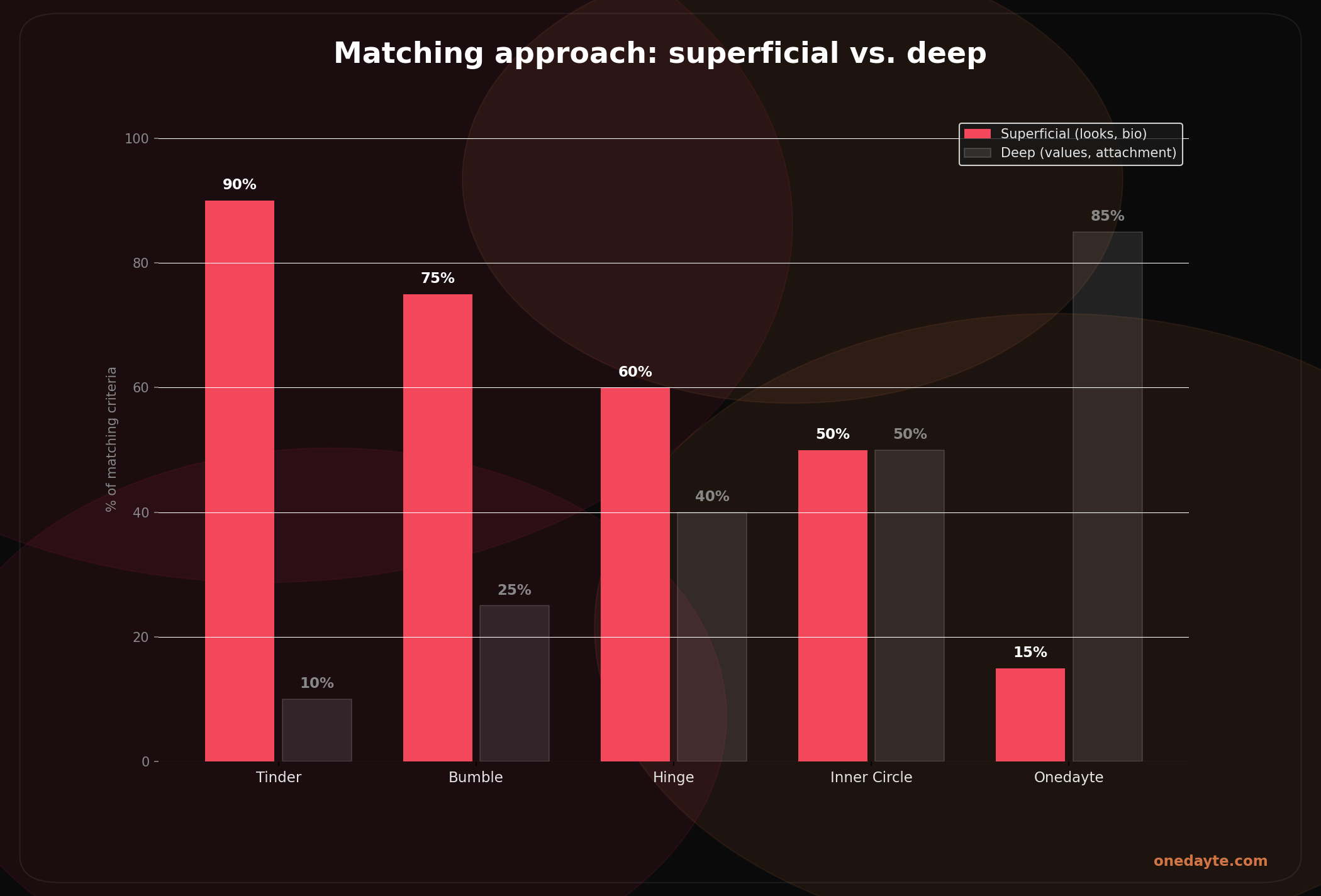
That explains why mainstream apps like Tinder often disappoint this group. The swipe model is designed around visual assessment and quick decisions. Precisely the opposite of what this target audience is looking for.
The options compared
Parship
Parship is one of the longest-running dating platforms for highly educated people, with a large membership base in the Netherlands and Europe. Matching is based on a personality test according to the Big Five model: openness, conscientiousness, extraversion, agreeableness and neuroticism. The price is at the higher end: expect 25 to 50 euros per month.
Parship's strong point is its serious user base. Those willing to pay are typically also serious in their search. The weak point is the matching itself. Research by Joel et al. (2017) shows that personality similarity on its own is a poor predictor of relationship success. Two extraverted people are not necessarily a good match.
e-Matching
e-Matching is a Dutch platform that has existed since 1998 and targets people with higher professional or academic education. The major advantage is that all profiles are manually reviewed, which increases quality and minimises fake profiles. It is more affordable than Parship, with prices starting from around 15 euros per month.
The limitation is that e-Matching is entirely profile-based. You search yourself based on criteria such as age, location and education. There is no scientific matching behind the suggestions. It is essentially a filtered database, not a matching system.
Onedayte
Onedayte takes a fundamentally different approach. Instead of matching on profile or personality type, Onedayte measures the factors that research has shown to predict relationship success: attachment style, emotional responsiveness and conflict style.
Through an Attachment Scan (12 scenario questions) and an AI-driven Doctor Conversation (12 to 15 messages), a deep relational profile is built. Photos are gradually released through the Progressive Reveal system: first the person, then the face. And the anti-swipe model limits the number of matches to 3 to 5 per day, each with a high compatibility score.
Why education alone is not enough
Here lies an important insight that many platforms miss. Education level is not a predictor of relationship success. Two people with a master's degree in the same field can have a disastrous relationship if their attachment styles clash. And two people with a completely different background can build a deep, stable connection if their relational patterns are compatible.
What does work as a predictor: shared values (not shared hobbies), emotional intelligence, and attachment compatibility. These are the factors that determine whether two people can not only have an enjoyable conversation, but also navigate through a crisis.
An interesting finding from research at Radboud University is that highly educated people often have higher expectations of a relationship. They are not just looking for a partner, but for an intellectually equal companion, an emotionally available pillar of support and a co-creator of a meaningful life. Those expectations are not unrealistic, but they do require a matching method that goes beyond a profile photo and a list of hobbies.
That is precisely the point where most platforms fall short. They filter on education, income and age. Useful basic filters, without doubt. But the question they leave unanswered is: how does this person behave when things get difficult? How do they react when you are having a bad day? How do they communicate when there is a disagreement? Those questions determine the difference between a nice first date and a relationship that lasts ten years.