Paradox of choice: why more matches lead to worse relationships
Onedayte Redactie
Expert at Onedayte

Imagine: you're standing in a supermarket in front of a shelf with 6 types of jam. You taste a few, you choose, you're satisfied. Now imagine there are 24 types. You taste, you hesitate, you walk away without buying anything. Or you buy something and spend the rest of the day wondering if it was the right choice.
This is the paradox of choice, described by psychologist Barry Schwartz. And it explains why dating apps with millions of users don't make you happier, but actually less satisfied.
What is the paradox of choice?
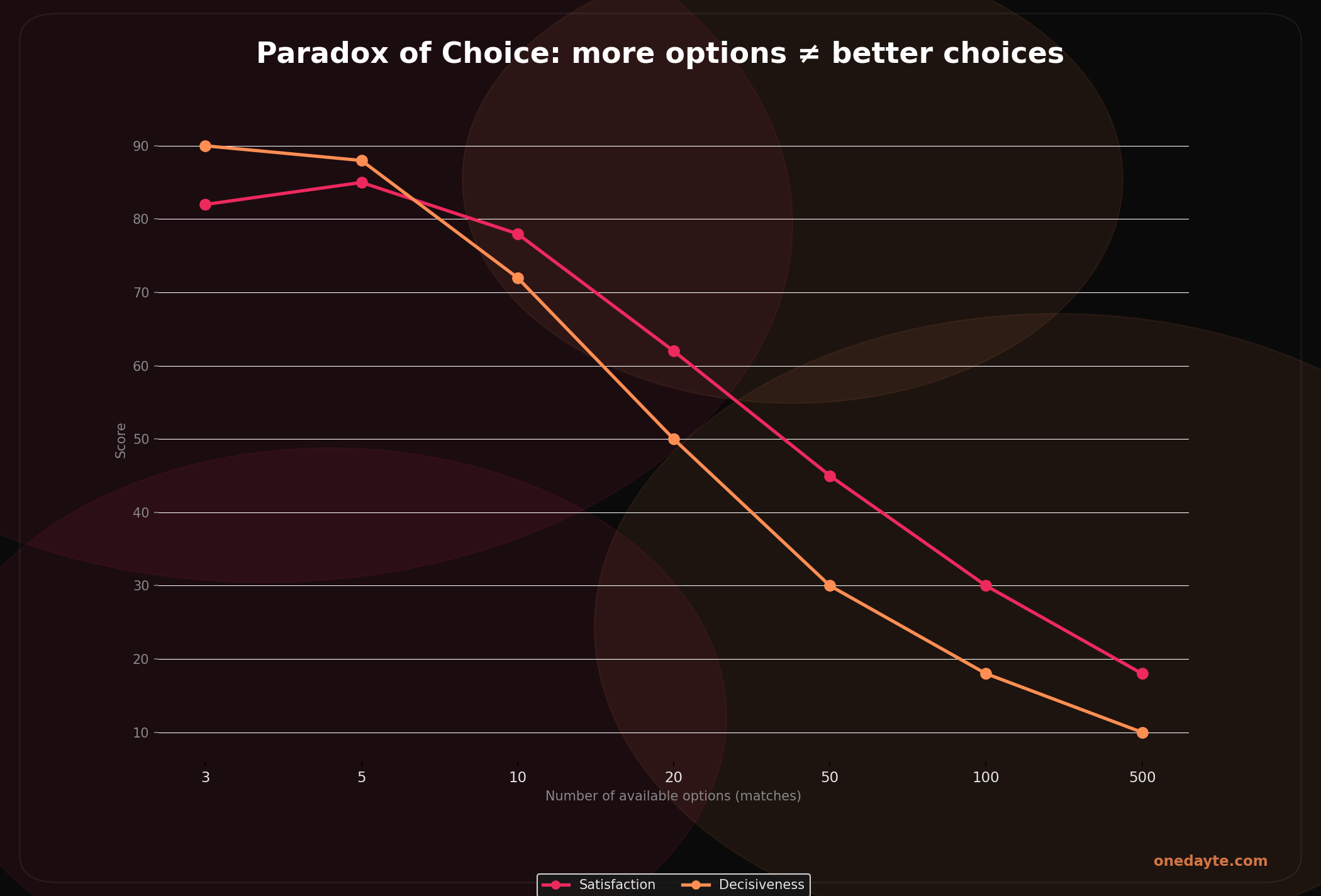
In the famous study (2000, published in the Journal of Personality and Social Psychology), customers could taste 6 or 24 types of jam. The group with 6 options actually purchased a jar six times more often. More choice didn't lead to better decisions. It led to paralysis, doubt, and lower satisfaction with the eventual choice.
Schwartz broadened the concept. In his TED Talk (one of the most viewed ever), he explained that this pattern applies to virtually every domain: from jeans to career choices to relationships. More options feel like freedom, but function as a prison.
How dating apps maximise choice overload
On Tinder alone, millions of profiles are available. Every swipe reveals a new face, a new possibility, a new opportunity you might miss if you choose now. This creates FOMO: the fear that there's always someone better, just one profile away. And FOMO is the enemy of commitment.
Schwartz distinguishes two types of decision-makers: maximizers (people who always want the best option) and satisficers (people who are content with good enough). His research shows that satisficers are consistently happier with their choices. The problem with dating apps is that they force satisficers to behave like maximizers. The supply is endless, so why settle for good enough?
A journalist and researcher from Vogue Nederland put it aptly: dating apps have turned dating into a kind of shopping, where people are compared as if they were items of clothing. The continuous stream of profiles creates the feeling that there's always someone else waiting if things don't work out.
What fewer choices do for your satisfaction
Research consistently confirms that limited options lead to higher satisfaction with the eventual choice. Not because the options are objectively better, but because your brain spends less energy evaluating alternatives and more on appreciating what you have. You invest more deeply in what's there, instead of wondering what could have been.
Translated to dating: someone who receives 3 carefully selected matches per day invests more in each profile than someone who scrolls through hundreds of profiles. That investment leads to deeper conversations, more genuine connections, and ultimately higher satisfaction.
Onedayte's anti-swipe model
Onedayte shows a maximum of 3 to 5 matches per day. No swipe mechanism. With each match, you choose 'I want to know more' (which starts the Guided Connection) or 'Not for me' (with optional feedback that refines the algorithm). Every match shown has already passed a high compatibility score across three layers: dealbreakers, attachment compatibility, and weighted matching.
The result: fewer choices, but better choices. And science confirms that this is precisely the key to satisfaction.
A common objection is that limited choice reduces your chances. That feels logical, but it's a thinking error. It's not about the quantity of options, but the quality. Three matches filtered on attachment compatibility, shared values, and emotional responsiveness give you a better chance of a lasting relationship than three hundred profiles selected on a photo and a location.
Moreover, research shows that investment per match increases when there are fewer options. You read the profile more carefully, you ask better questions, you give the interaction more of a chance. That deeper investment leads to conversations that are actually about something, instead of yet another 'hey, how are you?' that dies after two messages.
Sources: Schwartz (2004), Iyengar & Lepper (2000)