Personality and relationships: what Big Five and MBTI do and don't predict
Onedayte Redactie
Expert at Onedayte

Personality tests are everywhere in the dating world. Boo matches on MBTI types. Parship uses the Big Five. Hinge lets you fill in personality prompts. And on social media, millions of people share their INFJ, ENFP, or INTJ label as if it were an identity. The idea is tempting: if we know who you are, we can predict who suits you.
But is that true? The honest answer is: partly. Personality tests measure something real. But what they measure isn't the thing that makes the difference in relationships.
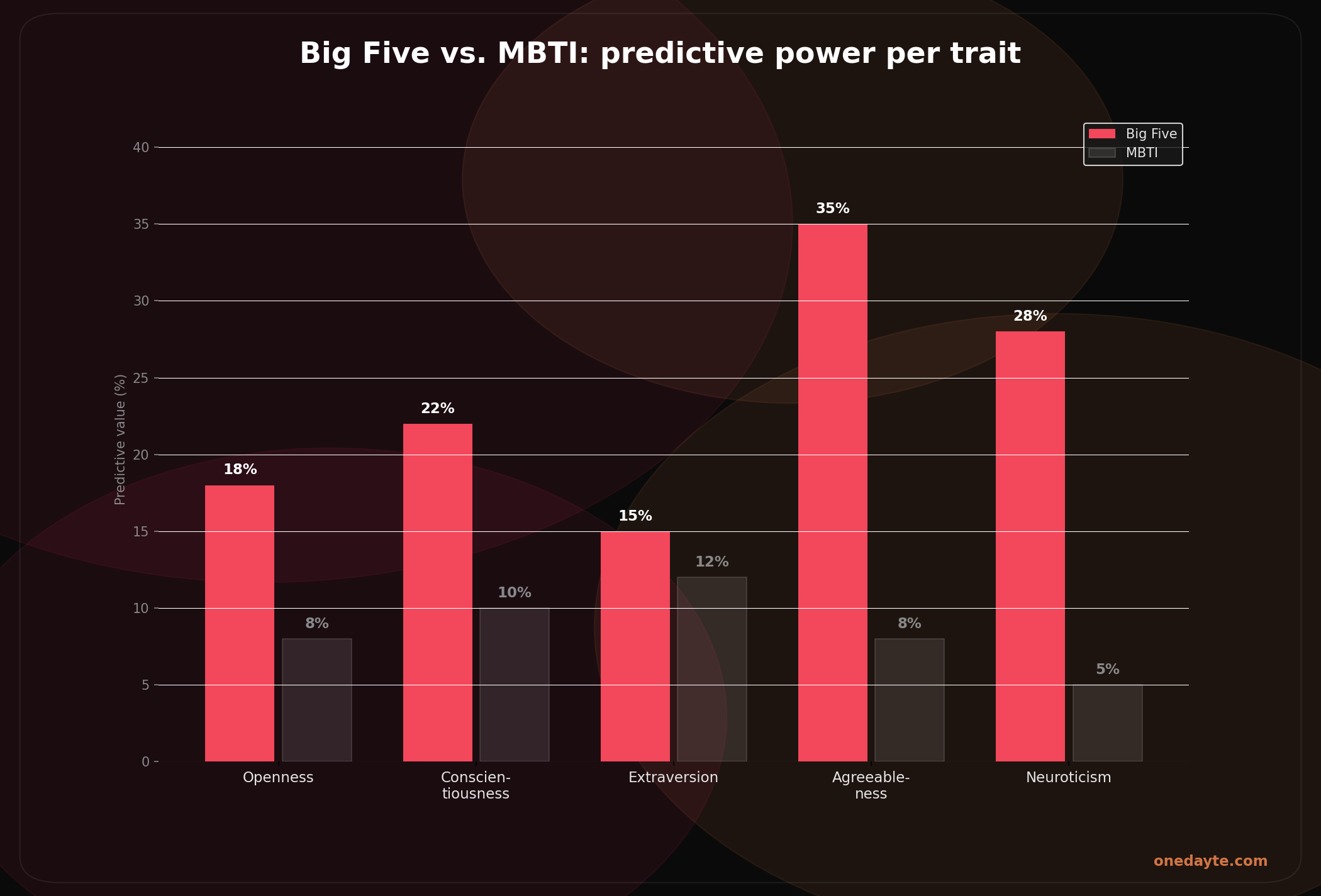
The Big Five: the best validated model
The Big Five (openness, conscientiousness, extraversion, agreeableness, and neuroticism) is the best validated personality model in psychology. The work of Costa and McCrae laid the foundation that has since been confirmed and replicated in thousands of studies. Unlike many popular personality tests, the Big Five has good test-retest reliability: if you take the test again after six months, you'll largely get the same scores.
There are correlations with relationship satisfaction. High agreeableness is associated with more harmonious relationships. High neuroticism with more conflict and dissatisfaction. These correlations are statistically significant, meaning they exist.
The problem is that they're weak. They explain a small percentage of the variation in relationship success. Joel et al. confirmed this with machine learning: when they ran all available personality data through their model, it explained only a fraction of the variation in romantic attraction. The vast majority of what determines whether two people feel a click lies not in their individual personality traits, but in the unique dynamic that emerges when they're together.
The fundamental limitation is conceptual. The Big Five describes who you are as an individual. How you function in the world in general. But a relationship is not an individual matter. A relationship is an interaction between two people. And how that interaction unfolds is determined by factors the Big Five doesn't measure: how you respond to intimacy, how you deal with conflict, whether you're emotionally available when your partner needs you.
MBTI: popular but scientifically problematic
Myers-Briggs (MBTI) is the personality test you encounter most often on social media and dating apps. INFJ, ENFP, INTJ: these are labels people love to share, compare, and use as selection criteria when swiping.
The scientific problem is substantial. MBTI has low test-retest reliability. When retested after five weeks, about 50 percent of people receive a different type. An instrument that yields different results upon repetition is not suitable as a basis for a decision as important as who you enter a relationship with.
Moreover, MBTI works with binary categories (you're either extraverted or introverted, there's nothing in between) while reality is a continuum. Most people fall somewhere in the middle, meaning the type they receive strongly depends on their mood at the time of the test. Most academic psychologists regard MBTI as entertainment, not serious science.
What does work: measuring relational dynamics
The alternative to personality tests is measuring the dynamics between two people. Not who you are as an individual, but how you function in relation to another. Attachment style: how do you respond to closeness and distance? Emotional responsiveness: are you available when the other person needs you? Conflict style: how do you react when things get difficult? Repair skill: can you move toward the other person again after an argument?
These are the factors that research identifies as predictive of relationship success. They're also the factors Onedayte measures through the Attachment Scan (12 scenario questions) and the Doctor Conversation (12 to 15 messages with an AI coach). Not who you are on paper, but how you function in a relationship. That difference sounds subtle, but it's fundamental — and it's the difference between a match based on marketing and a match based on science.
It's the difference that determines whether after six months you still wake up happily next to someone, or wonder how you ended up here.
Sources: Costa & McCrae (1992), research on MBTI validity