Relationship compatibility: what does science really say?
Onedayte Redactie
Expert at Onedayte

Does this person suit me? It's the question every dater asks themselves, with every match, every date, every moment of doubt. And the answers we give ourselves are almost always based on the wrong criteria.
We think compatibility is about shared hobbies, the same taste in music, both loving to travel. It feels logical: people with a lot in common must be a good fit. But research consistently contradicts this.
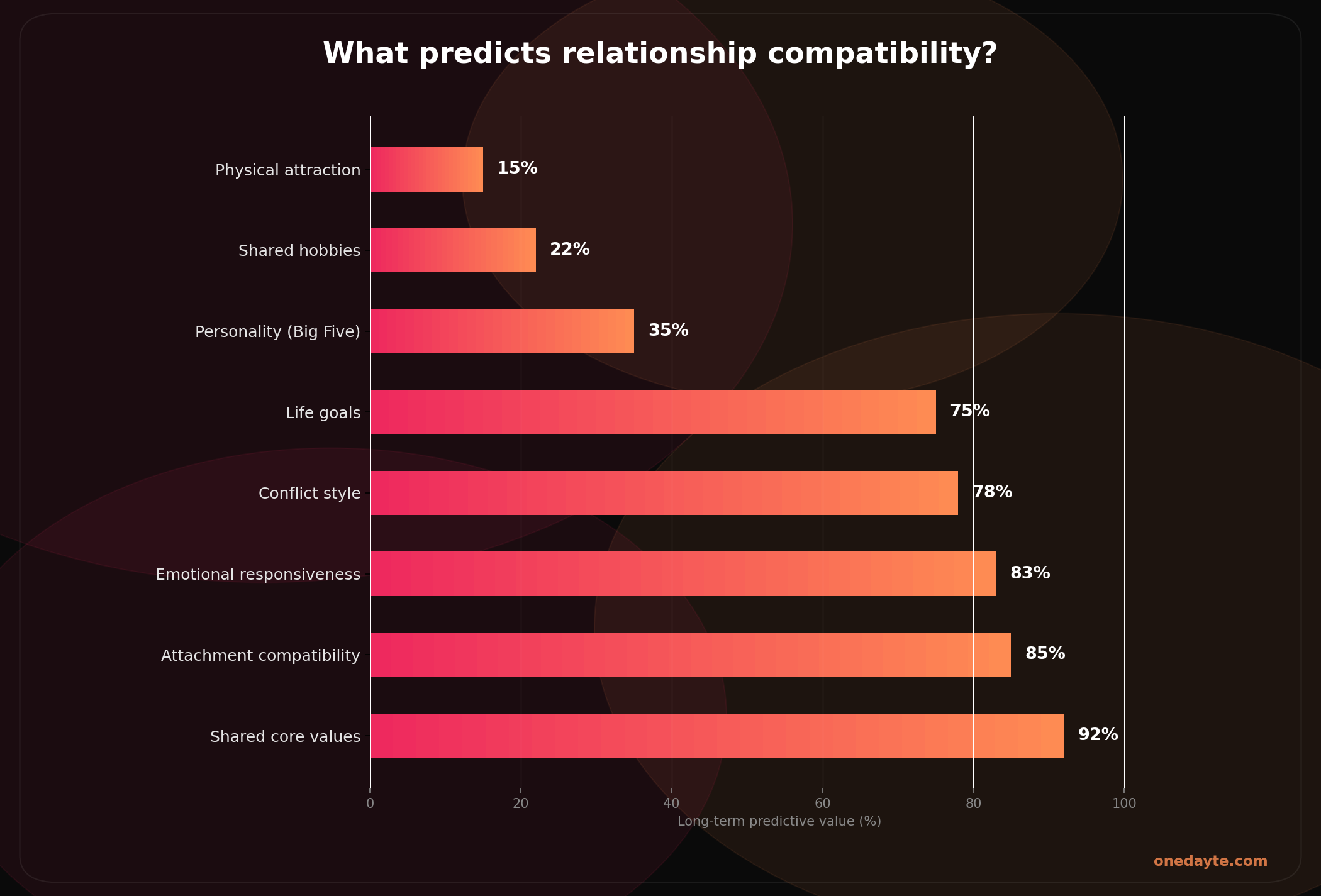
What compatibility is not
Joel and colleagues (2017) demonstrated with machine learning that shared interests and personality similarity barely predict whether two people build a good relationship. Two people who both love running and Italian food don't have a better chance of a happy relationship than two people with entirely different hobbies.
Education level and socio-economic status are also poor predictors. Two people with a PhD can have a disastrous relationship if their attachment styles clash. An accountant and an artist can build a wonderful life together if they share the same values and understand each other's emotional needs.
The reason is that superficial similarities don't determine how two people behave when things get difficult. And it's precisely in those difficult moments that a relationship is tested. Who is available when you're having a bad day? Who truly listens when you voice your concerns? Who is able to move toward you again after an argument?
What compatibility actually is
Research consistently points to three factors that make the difference. Attachment compatibility: do your attachment styles complement each other, or do they reinforce a destructive pattern? An anxiously attached person combined with an avoidantly attached person creates the well-known pursuer-distancer cycle. That same anxiously attached person with a securely attached partner experiences calm and stability.
Shared values: not shared hobbies, but shared fundamental beliefs about loyalty, family, freedom, growth, and how you handle money. Gottman calls this shared meaning: the shared life story you write together. Two people who both place freedom and adventure at the top make different choices than two people who prioritise stability and security. Neither is better, but they must be compatible.
Complementary conflict styles: not the same conflict pattern, but the skill to navigate together when things get difficult. Two avoidant conflict styles lead to unspoken frustrations. Two confrontational styles lead to escalation. The balance lies in the ability to recognise and respond to repair attempts.
How Onedayte measures compatibility
Onedayte's three-layer algorithm first filters on dealbreakers (binary), then on attachment compatibility (via the Attachment Scan), and then calculates a weighted compatibility score based on emotional responsiveness, conflict style, shared values, and more. Each layer builds on the previous one, so only matches that score sufficiently at all levels get through.
The result is not a perfect match — because that doesn't exist — but a match with a significantly higher chance of a lasting, fulfilling relationship. Two people who have passed through three layers of filtering share not only the same dealbreakers and a healthy attachment dynamic, but also the emotional and communicative skills to navigate a relationship through the inevitable storms.