Relationship pace: when does it get serious? What science says
Onedayte Redactie
Expert at Onedayte

After how many dates do you declare exclusivity? When do you introduce someone to your friends? When do you say 'I love you' for the first time? When do you move in together? There are no fixed rules, and anyone who claims there are is selling a simplification. But there is research that helps you find a healthy pace.
The core principle is not speed or slowness. It's intentionality. The relationships that most often go wrong are not the ones that move too fast or too slow, but the ones where the pace isn't consciously chosen.
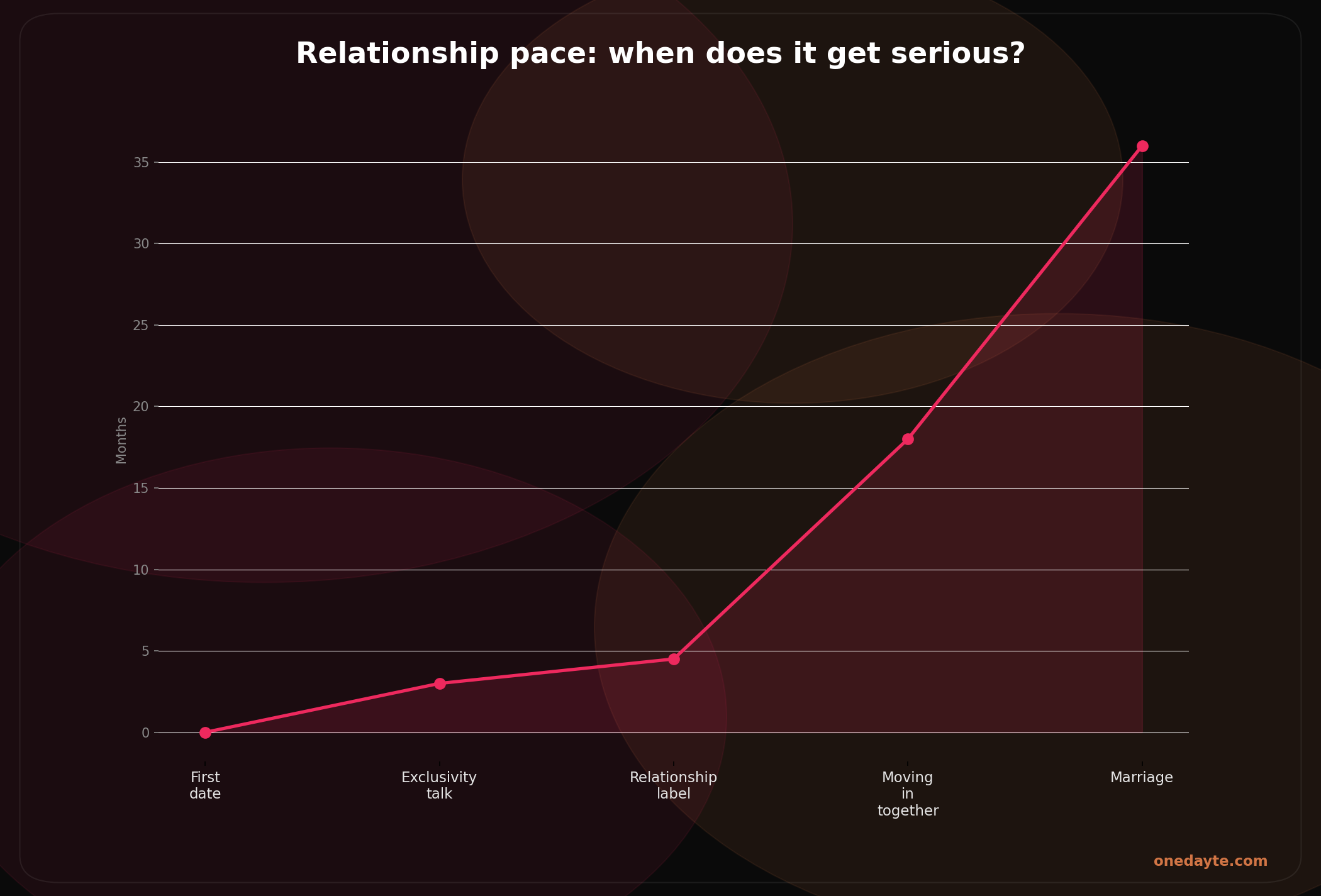
Why pace matters
Moving too fast can signal several things. Sometimes it's genuine enthusiasm. Sometimes it's love bombing — a pattern where someone overwhelms you with attention and commitment to make you emotionally dependent. And sometimes it's an attachment pattern driven by intensity: anxiously attached people seek reassurance quickly, and the fastest route to reassurance is putting a label on things fast.
Moving too slowly can also be telling. It may indicate avoidant attachment: someone who wants the relationship but postpones the confrontation with real intimacy. It may indicate deliberately keeping options open: the FOMO that dating apps feed. Or it may simply mean that someone is cautious after previous disappointments.
The right pace is the pace at which both partners feel comfortable and that is honestly discussed. Not the pace that one partner imposes while the other goes along out of fear of losing them.
What research says about important milestones
Research published in the Journal of Marriage and Family shows that couples who move in together quickly (within 6 months of the start of the relationship) have a higher chance of divorce than couples who wait longer. The explanation is not that moving in together quickly is inherently bad, but that it's often a slide rather than a conscious choice. They slid into it (the rent was high, it was practical, we were at each other's place every evening anyway) instead of choosing it.
"Rapid transitions into coresidence are associated with poorer relationship quality and a higher likelihood of dissolution."
— Sassler, Journal of Marriage and Family, 2010
This phenomenon is called relationship inertia: the tendency to continue a relationship simply because you're in it, not because you consciously choose it. It applies not only to moving in together, but to every milestone: exclusivity, meeting each other's families, sharing finances. The pattern is consistent: conscious choices lead to better outcomes than choices that arise from convenience or pressure.
Another telling study, published in Personal Relationships, followed 168 couples from their wedding day for 13 years. The finding: couples who experienced a gradual, calm increase in intimacy during the dating phase had the best long-term prognosis. Couples who had a turbulent, intense early phase (many highs but also many conflicts) had the worst. It's not the intensity of the beginning that predicts, but the stability.
"Couples with turbulent courtships were more likely to experience declines in love and increases in ambivalence over time."
— Huston et al., Journal of Personality and Social Psychology, 2001
The exclusivity conversation
One of the most dreaded moments in modern dating is the define-the-relationship conversation, also known as the DTR conversation (Define The Relationship). The fear of it is universal: what if the other person doesn't want the same thing? What if I ruin it by bringing it up?
That fear is understandable but unproductive. Research shows that ambiguity about the status of a relationship is associated with lower relationship satisfaction, more anxiety, and more conflicts. Clarity — even if the answer isn't what you hope for — is better for your well-being than chronic uncertainty.
There's no perfect moment for the conversation. The right moment is when you feel the need for it and can formulate it as an honest question, not an ultimatum. 'I enjoy spending time with you and I notice I'm wondering what this is for you. How do you see where we stand?' That phrasing invites openness without pressure.
How Onedayte facilitates a healthy pace
The entire Onedayte system is designed to support a healthy pace. The Progressive Reveal system deliberately slows down the visual assessment. The Guided Connection structures the first conversations so they gradually become deeper. And the limited number of matches per day prevents you from having five conversations simultaneously and giving none of them the attention they deserve.
The philosophy is: fast enough to maintain momentum, slow enough to make conscious choices. That's not a restriction. That's design in service of your interest.
Sources: longitudinal relationship research, demographic data