Best dating apps in the United States: 2026 comparison
Onedayte Editorial
Expert at Onedayte
The American dating market is crowded. Tinder, Bumble, Hinge, Match.com, eHarmony, OkCupid, Breeze, Boo, Muzz, and ever more new names. Each platform promises the solution to your love life. But behind the marketing lie fundamentally different approaches, and not all of them are equal.
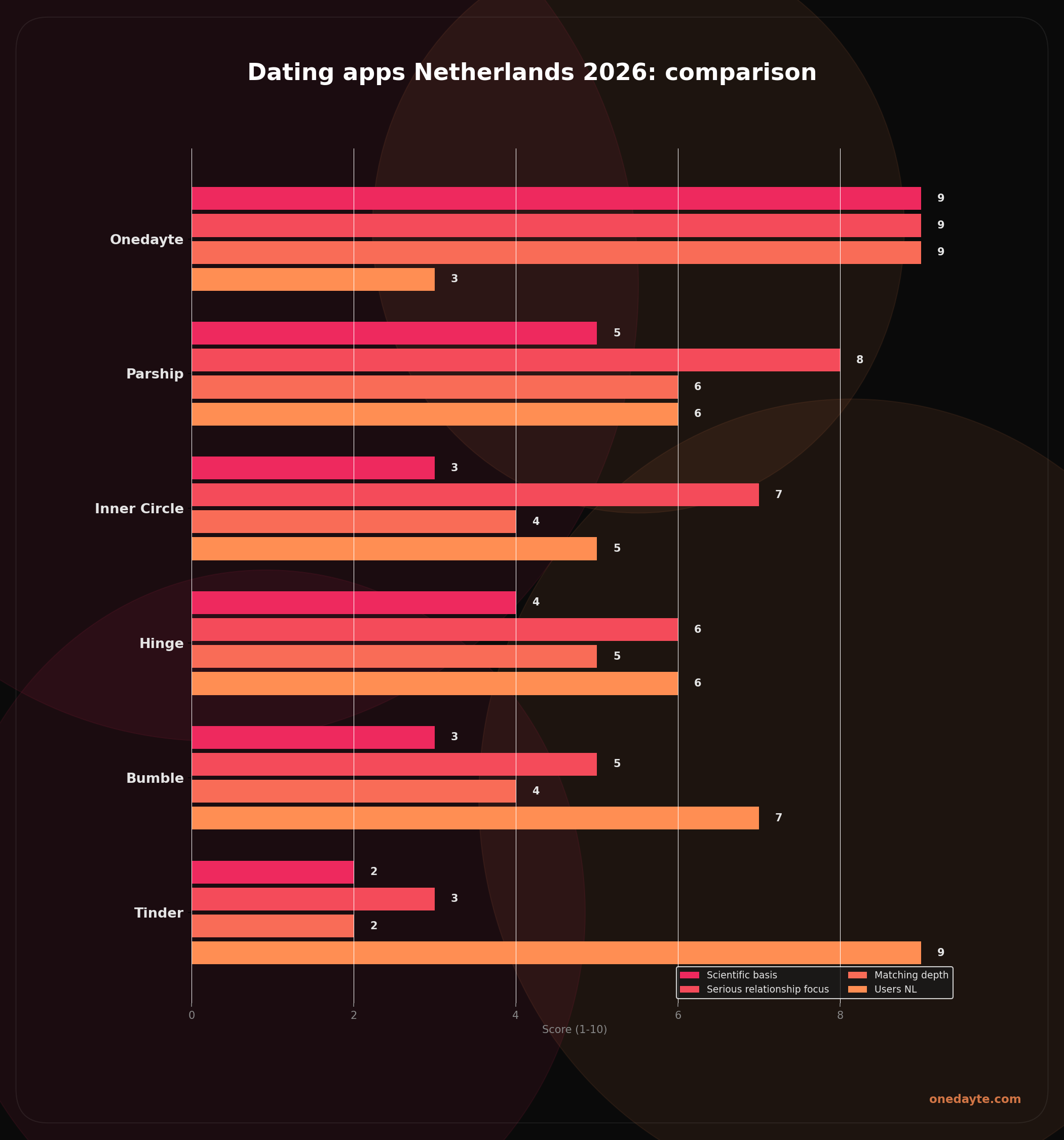
In this comparison, we look beyond the slogans. We evaluate each app on three criteria: the quality of the user base, the matching method, and the extent to which the platform facilitates genuine connection.
Tinder
The largest dating app in the world and the name that has become synonymous with online dating. Its reach is unmatched: millions of users in the United States. Matching is entirely based on photos, location and age. That makes it the most superficial option in this overview, but also the option with the broadest audience. Suitable for casual dates and those who mainly want to meet lots of people. Less suitable for those specifically looking for a lasting relationship.
Bumble
Comparable to Tinder in terms of the swipe mechanism, but with one important difference: in heterosexual matches, the woman must send the first message. This reduces unwanted messages and somewhat improves the quality of conversations. The speed dating feature on Thursday evenings is an original addition. Bumble also has a BFF mode for friendships and Bizz for professional networking.
Hinge
Popular among 25 to 35-year-olds who are searching more seriously. Profiles are more detailed than on Tinder and contain prompts that stimulate conversations. The daily number of likes is limited, which forces more deliberate choices. Hinge's slogan 'The app designed to be deleted' suggests a focus on results. In practice, matching is still largely profile-based, but the conversation structure is a step forward.
Match.com
One of the oldest and largest dating platforms in the United States, with a user base that skews towards 30+. Profiles are more detailed than on swipe-first apps and the platform offers both algorithmic suggestions and manual search. Match also organizes offline events in major cities, bridging the gap between online and offline dating.
eHarmony and OkCupid
Both target users with serious intentions. eHarmony uses an extensive compatibility quiz based on psychological dimensions and has a large user base across the United States. The price is premium ($30 to $60 per month), which filters the user base for serious intentions. OkCupid offers a free tier with detailed questionnaires and is popular among younger demographics. Both are strong options for those willing to invest, although scientifically speaking the matching is limited to personality similarity.
Boo
The MBTI dating app that is gaining popularity in the United States. Matching is based on Myers-Briggs personality types. The concept is appealing for those interested in personality typology, but the scientific basis is weak. MBTI has low test-retest reliability and has not been validated as a matching tool.
Onedayte
The newcomer that takes a fundamentally different approach. No swipe mechanism. Matching based on attachment style, emotional responsiveness and conflict style via an Attachment Scan and AI-driven Doctor Conversation. Progressive Reveal: photos only become visible after the first conversations. Guided Connection: structured Love Maps questions instead of an open chat. A maximum of 3 to 5 matches per day. Aimed at those willing to invest in finding a lasting relationship based on the factors that scientific research identifies as predictive.
Source: comparison based on platform analysis 2026