Engstelig tilknytningsstil: kjennetegn, mønstre og vekst
Onedayte Redaksjonen
Ekspert hos Onedayte

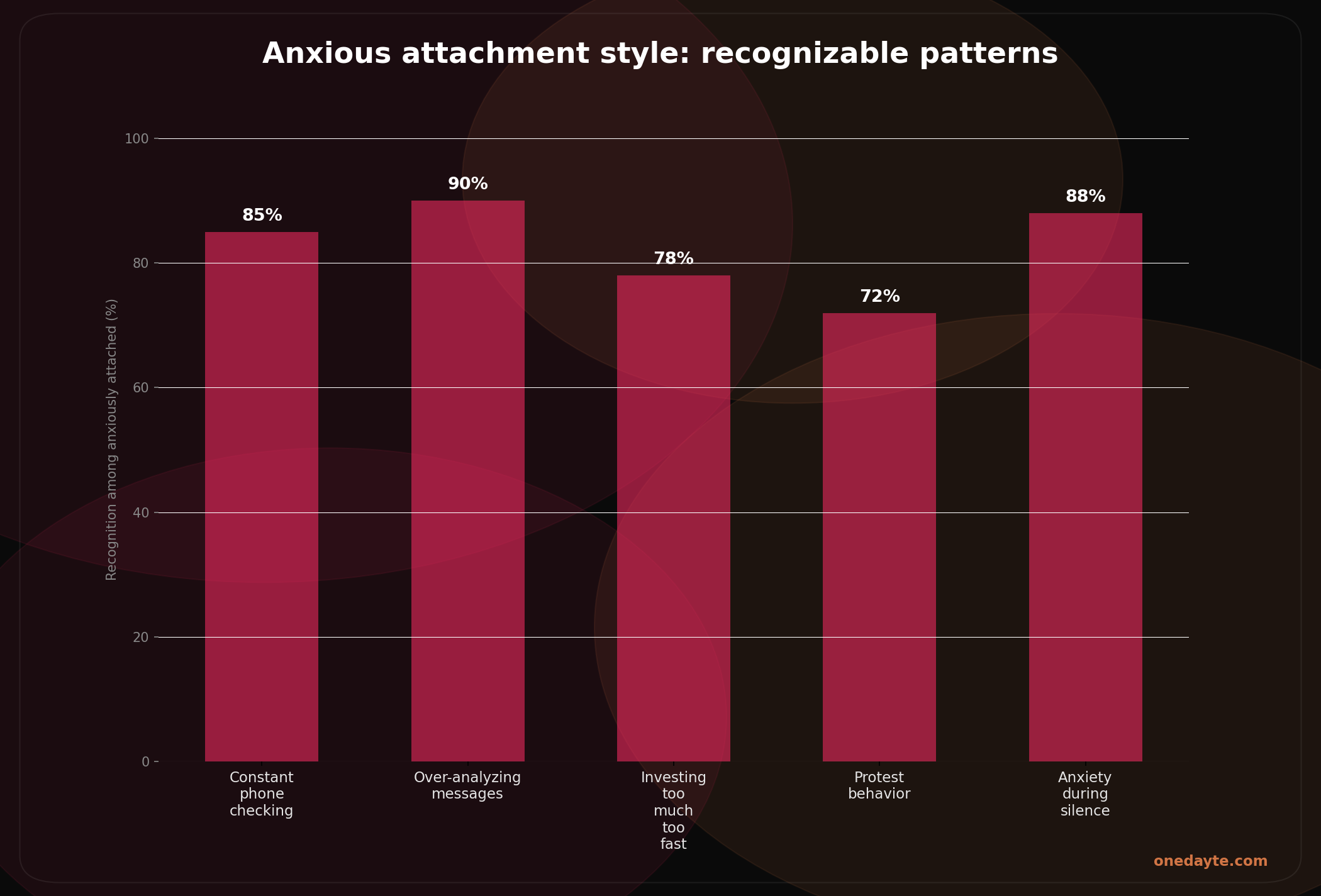
You check your phone every five minutes. You analyse every message for hidden meanings. A short reply from your partner ('ok') can occupy your mind for an entire evening. If he or she comes home later than expected, your heart starts beating faster. Not from excitement, but from anxiety. The thought that keeps returning: is this person going to leave me?
This is what an anxious tilknytningsstil looks like in daily life. It affects an estimated 20 prosent of the adult population. It is not a disorder, not a diagnosis and not a character flaw. It is a pattern that formed in response to your early experiences, and it steers your dating behaviour in ways you often do not realise.
Hvordan engstelig tilknytning utvikler seg
Attachment theory, developed by John Bowlby and Mary Ainsworth, describes how the bond with your first caregivers forms a blueprint for all your later forholds. Anxious attachment develops when your caregivers were inconsistent in their availability. Sometimes they were warm, involved and responsive. Sometimes they were absent, distracted or emosjonelt utilgjengelig. That fluctuating pattern taught you as a child that love is not reliable. It is there, but you never know when it will disappear.
What you learned as a child was hypervigilance. You developed a finely tuned radar system for signals of rejection or abandonment. Every small sign that your parent was less available activated your alarm system. You carry that wiring into your adult forholds. The radar system that once served your survival now steers your dating behaviour in ways that are often counterproductive.
Research by Mikulincer and Shaver (2007), summarised in their work Attachment in Adulthood, confirms that these patterns are remarkably stable across the lifespan. That does not mean they are unchangeable. It does mean they require conscious effort to adjust.
"The tilknytningssystemet remains active across the lifespan, continuing to shape emotional and relational functioning in adulthood."
— Mikulincer & Shaver, Attachment in Adulthood, 2007
Kjennetegn i forhold og dating
The most visible trait is the strong need for reassurance. Not as superficial vanity, but as a deep emotional need to know that the other person is still there. This manifests in frequent messaging, checking whether the other person has been online, and interpreting silence as rejection. Psychologists call this protestatferd: behaviour intended to regain the attention and proximity of the tilknytningsfigur.
"If you are anxious, the activated tilknytningssystemet will make you feel as though you can't live without your partner."
— Levine & Heller, Attached, 2010
On dating-apps, this translates into a recognisable pattern. You check the app obsessively. A new match provides brief relief, but as soon as the conversation goes quiet, anxiety strikes. You tend to invest too much too early: overly long messages, too-quick availability, too much emotional openness before the other person is ready for it. Not because you want too much, but because your nervous system cannot bear waiting in uncertainty.
In existing forholds, it manifests as worrying about your partner's intentions. Small changes in behaviour (a shorter hug, a less enthusiastic message, an evening out with friends without you) are interpreted as a precursor to abandonment. The urge to resolve conflicts immediately is strong, even when the timing is not right. The inability to tolerate unresolved tension drives you to want to have a conversation at two in the morning that would be better left until tomorrow.
Fellen engstelig tilknyttede datere faller i
The biggest pitfall is the attraction to unnvikende tilknyttet partners. Research by Fraley Lab confirms that engstelig tilknyttet people are disproportionately attracted to unnvikende tilknyttet partners. The apparent independence of the avoidant feels like strength and stability, precisely what the engstelig tilknyttet person feels they lack in themselves.
But that combination is a recipe for the forfølger-distanserer cycle. The more the engstelig tilknyttet partner pursues (seeking more contact, asking for more reassurance, wanting to talk more), the more the avoidant partner withdraws. And the more the avoidant withdraws, the greater the anxiety of the engstelig tilknyttet person. A spiral that exhausts both partners and rarely stops on its own.
The second pitfall is confusing intensity with love. The strong feelings you experience with an unavailable partner (the euphoria upon reunion, the panic during distance) activate the same brain regions as being in love. But it is not love. It is your tilknytningssystemet in overdrive. Real love feels like calm, not like a rollercoaster.
Hvordan håndtere det
Recognise your triggers. Make a list of the situations that activate your anxiety. Partner does not respond to a message? Partner goes out without you? Partner is less enthusiastic than usual? By knowing your triggers, you can learn to distinguish between a real signal and a false alarm from your tilknytningssystemet.
Communicate your needs without blame. There is a fundamental difference between 'I feel insecure when I do not hear from you for a long time' and 'Hvorfor you never reply?' The first sentence invites understanding. The second sentence invites defensivitet. The art is to express your need from your feeling, not from your fear.
Consciously seek a trygt tilknyttet partner. That may feel less exciting at first than the familiar rollercoaster, but forskningen is crystal clear: a trygt tilknyttet partner is the most powerful instrument for shifting your tilknytningsstil towards greater security. The calm you experience is not boredom. It is the foundation of a forhold that builds you up instead of wearing you out.
Sources: Mikulincer & Shaver (2007), Fraley Lab