Gottmans fire ryttere: mønstre som ødelegger forhold
Onedayte Redaksjonen
Ekspert hos Onedayte

John Gottman observed thousands of par in his Love Lab at the University of Washington for more than 40 years. He filmed their conversations, measured their heart rates, analysed their facial expressions. And he discovered something remarkable: he could predict with 91 prosent accuracy which par would divorce. Not based on how often they argued, but on how they argued.
"The success or failure of a marriage can be predicted with 91% accuracy based on the way a par discusses a topic of disagreement."
— Gottman Institute Research
The four communication patterns he identified, he called the fire ryttere of the apocalypse. They are the toxic habits that can hollow out any forhold from the inside. Den gode nyheten: for every horseman there is an antidote.
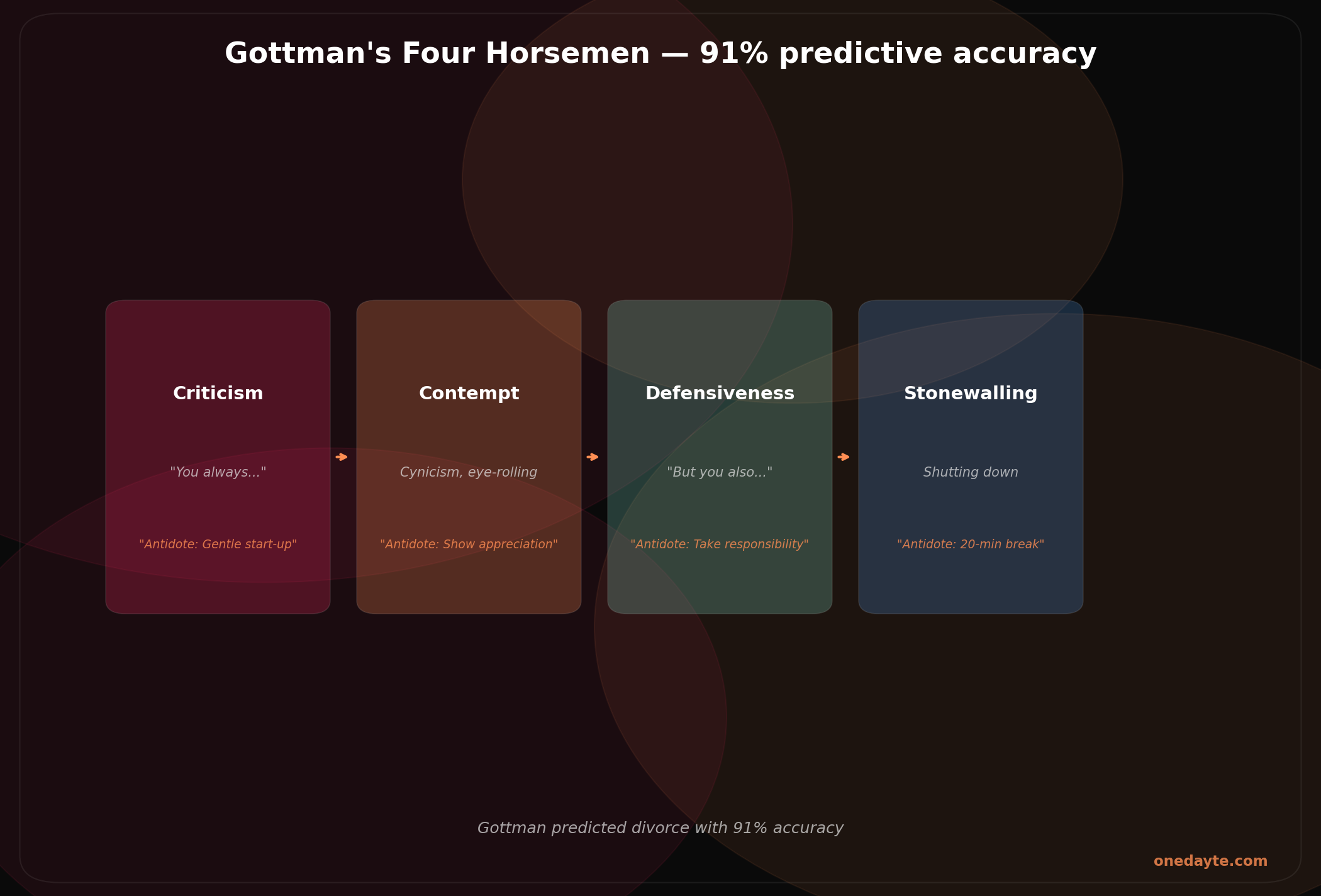
Rytter 1: Kritikk
There is a fundamental difference between a complaint and kritikk. A complaint is about specific behaviour: 'I find it annoying that you didn't do the dishes.' Kritikk attacks the character: 'You never do anything in the household. You're just lazy.' Forskjellen lies in the word 'you' combined with generalisations such as 'always' and 'never'.
The effect of kritikk is that your partner does not feel addressed about behaviour, but rejected as a person. And that activates a defensive reflex that immediately escalates the conversation.
The antidote is the myk oppstart, also known as myk oppstart. Begin a conversation with 'I' instead of 'you'. Name your feeling and your need, not the other person's failure. 'I feel stressed when the kitchen is messy. Can we agree on who tidies up when?' That single shift in phrasing makes forskjellen between a constructive conversation and an argument.
Rytter 2: Forakt
This is the most destructive horseman of all. Forakt manifests as sarcasm, eye-rolling, insults, a condescending tone or the feeling that you are better than your partner. It is more than unkindness. It is the signal that you do not respect your partner as an equal person.
"Forakt is the single greatest predictor of divorce, and it must be banned from forholds."
— John Gottman, What Predicts Divorce?, 1994
Gottman's research, published via the Gottman Institute, reveals something remarkable: forakt does not only destroy forholds, it even undermines the immune system of the receiving partner. Couples with a lot of forakt in their interaction are demonstrably ill more often. The explanation is that chronic emotional stress keeps the body in a permanent state of alertness.
The antidote is building a culture of appreciation. Gottman calls this hengivenhet og beundring: actively looking for what you value in your partner and expressing it regularly. Not as a trick, but as a conscious shift in where you focus your attention.
Rytter 3: Defensivitet
Defensivitet is the natural response to kritikk. It takes three forms: counter-attack ('Yes but what about you?'), making excuses ('I couldn't help it'), and playing the victim ('I do everything wrong in your eyes'). It feels like self-defence, but the message your partner receives is: your feelings do not matter.
The effect is always escalation. The partner who does not feel heard pushes harder. And the defensive partner retreats deeper into defence. A spiral without end.
The antidote sounds simple but is difficult i praksis: taking responsibility, even if only for a small part. 'You're right, I promised and it didn't happen. I'm sorry.' That single sentence can de-escalate an entire argument, because it gives your partner the signal that you are listening.
Rytter 4: Muring
Muring is emotionally shutting down. Putting up the wall, walking away, no longer responding, looking away as if the conversation does not exist. In Gottman's research, muring occurred more frequently in men in 85 prosent of cases, although it can occur in all genders.
The cause is almost always emotional flooding: the nervous system becomes so overstimulated that it switches to fight-or-flight mode. The heart rate goes above 100 beats per minute. At that point, constructive communication is biologically impossible.
The antidote is selvberoligning. Gottman recommends a break of minst 20 minutes. Say explicitly: 'I notice I'm becoming overstimulated. I'd like to take a 20-minute break and then continue talking.' The crucial addition: then actually come back. Muring without returning is avoidance. Muring with an agreed break is self-care.
Hvordan Onedayte oppdager de fire rytterne
In the Doktorsamtalen (Phase 3 of the Onedayte process), users are confronted with conflict scenarios. 'Your partner accuses you of not giving enough attention. Hva er your first reaction?' The AI analyses not only what someone answers, but how. Is there defensivitet in svaret? Avoidance? Or rather the ability to take responsibility? Those nuances are the data points that make forskjellen in matching.
Source: Gottman & Silver (1999), Gottman Institute