Hva gjør et forhold vellykket? 40 år med forskning oppsummert
Onedayte Redaksjonen
Ekspert hos Onedayte

Hva om du kunne forutsi på 20 minutter om et forhold vil vare? John Gottman can. After 40 years of research among thousands of par in his Love Lab at the University of Washington, he identified the factors that distinguish happy forholds from unhappy ones. The findings are surprisingly concrete and applicable to everyone.
The most striking insight: forskjellen doesn't lie in the big things. It lies in daily micro-interactions. In how you respond when your partner says something about their day. In whether you look up from your phone when she walks in. In the hundreds of small moments per week in which you choose to turn towards your partner or away from your partner.
De 5 pilarene i et vellykket forhold
Gottman visualises a healthy forhold as a house with floors, the Sound Forhold House. The foundation consists of Love Maps: know each other's inner world. Do you know what occupies your partner's mind, what they dream of, what worries them? Couples who regularly update each other's Love Maps are more resilient in the face of adversity.
Built on that is hengivenhet og beundring: actively showing appreciation for your partner. Not as a grand gesture on Valentine's Day, but as a daily micro-expression. 'I appreciate how you handled that situation.' 'I like how you talk to the children.' Small sentences, big impact.
The third floor is vende seg mot: responding to your partner's emotional signals. Every moment when your partner shares something, sighs, makes a remark, is a bid for connection. Do you respond with attention (vende seg mot) or do you ignore it (vende seg bort)? This single behaviour predicts with remarkable accuracy whether par stay together.
Above that: positivt sentimentoverskudd (giving the benefit of the doubt in ambiguous situations) and felles mening (building a shared life narrative and joint rituals together).
Hva vellykkede par gjør annerledes
5:1-forholdet is one of Gottman's most cited discoveries. Stable forholds have a ratio of minst 5 positive interactions for every negative one. Couples who achieved this ratio Gottman called the masters. Couples who fell below it: the disasters. Viktigly: it is not about grand gestures. It is about daily micro-interactions: a smile, a question, a compliment, a touch.
"Masters of forholds scan for what is going right in their forhold and express appreciation. Disasters scan for what is going wrong and criticize."
— John Gottman, Gottman Institute Research
Reparasjonsforsøk are the secret superpower. Moving back towards each other after every argument. Using humour to break the tension. Saying: 'I understand that you're angry.' Forskning viser that the ability to repair after conflict is more viktig than avoiding conflict. The 67 prosent of conflicts that are unsolvable (based on fundamental personality differences) need not be a problem, as long as you can navigate them without deploying the fire ryttere.
An often overlooked aspect of compatibility is timing. Two people who are currently in different life phases can be a perfect match on paper but get stuck i praksis. Someone who has just been through a difficult divorce and someone who is ready to buy a house together have different needs. That doesn't mean they are incompatible, but it does mean that timing plays a role you cannot filter out with an algorithm. What you can measure is the willingness to grow together and the emotional capacity to do so.
The first three minutes of a conflict conversation predict its outcome with 96 prosent accuracy. A soft start ('I notice that I feel...' instead of 'You always...') makes forskjellen between a constructive conversation and an escalation that can last hours or days.
What also stands out in Gottman's research is the importance of positive memories. Couples who look back on the beginning of their forhold with warmth and humour (how they met, the første date, the first holiday) have a significantly better prognosis than par who rewrite those memories with cynicism or indifference. It is as if the quality of your memories is an indicator of the quality of your current forhold. That insight underscores why the beginning matters: the first conversations, the first vulnerability, the first moments of genuine connection lay the foundation for years to come.
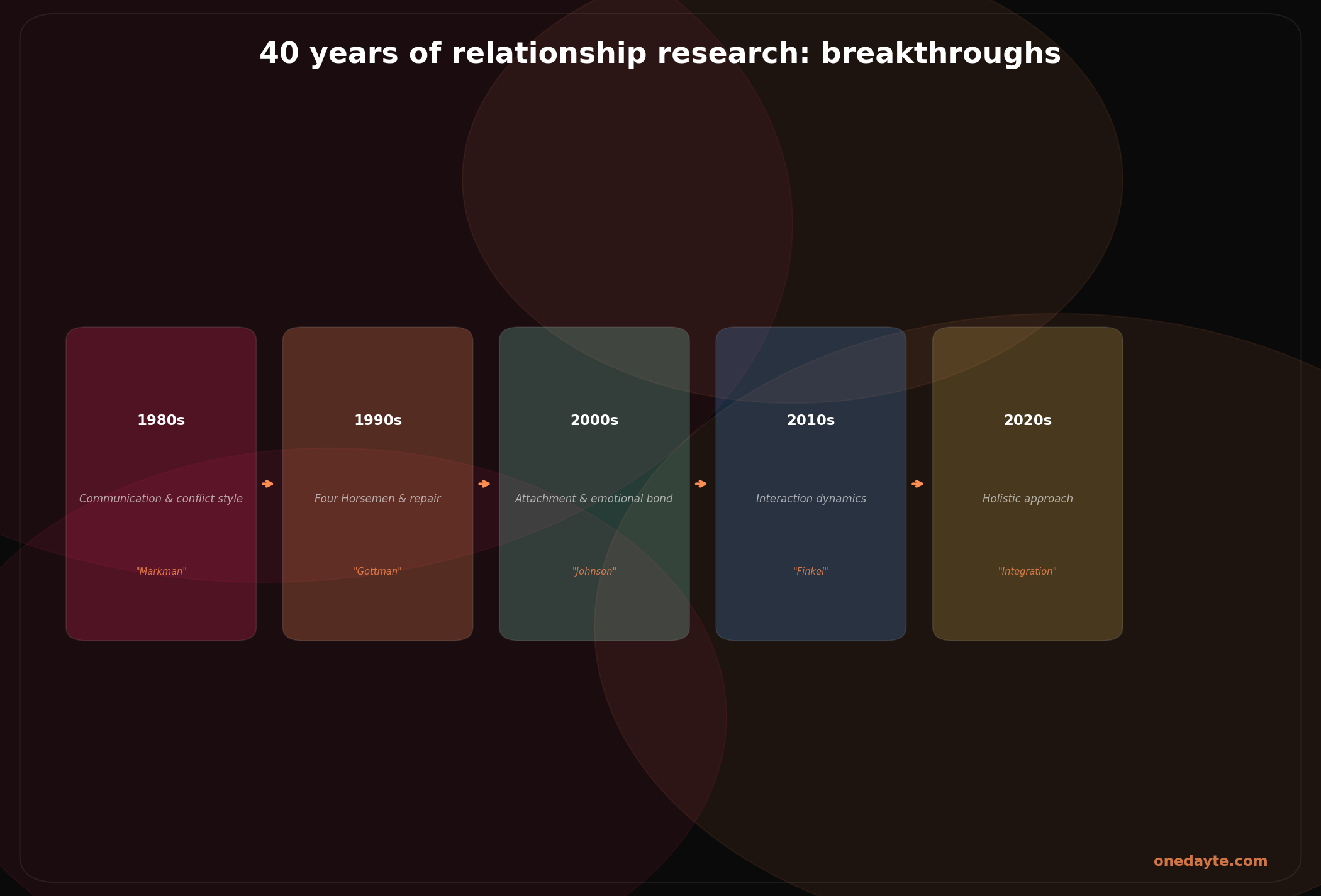
Source: overview of key contributions per decade