Attachment styles explained: discover your relational DNA
Onedayte Redactie
Expert at Onedayte

Why are some people totally relaxed in a relationship, while others constantly worry whether their partner truly sees them? Why does one person withdraw from intimacy, while the other seeks more closeness? Why do your relationships always end the same way, with the same frustrations, regardless of how different the new partner seemed?
The answer lies in your attachment style. A pattern that forms in your early childhood and that, like a kind of relational DNA, determines how you behave in romantic relationships, how you respond to conflict, and even who you're attracted to.
What is attachment theory?
Attachment theory was developed by psychiatrist John Bowlby and psychologist Mary Ainsworth in the 1950s and 60s. The core idea is as simple as it is profound: people have an innate need to attach to others. The quality of the bond with your first caregivers determines the pattern with which you later form relationships.
Ainsworth observed babies in the Strange Situation, an experiment in which the mother briefly left the room. Some babies were distressed but calmed quickly upon her return (secure). Others remained inconsolable for a long time (anxious). Still others appeared indifferent but showed internal stress (avoidant).
In 1987, Hazan and Shaver applied the theory to adult romantic relationships. They discovered that the same patterns recur in how adults love. Your attachment style as a baby predicts how you behave as an adult in love. Not deterministically, but as a strong pattern.
The four attachment styles
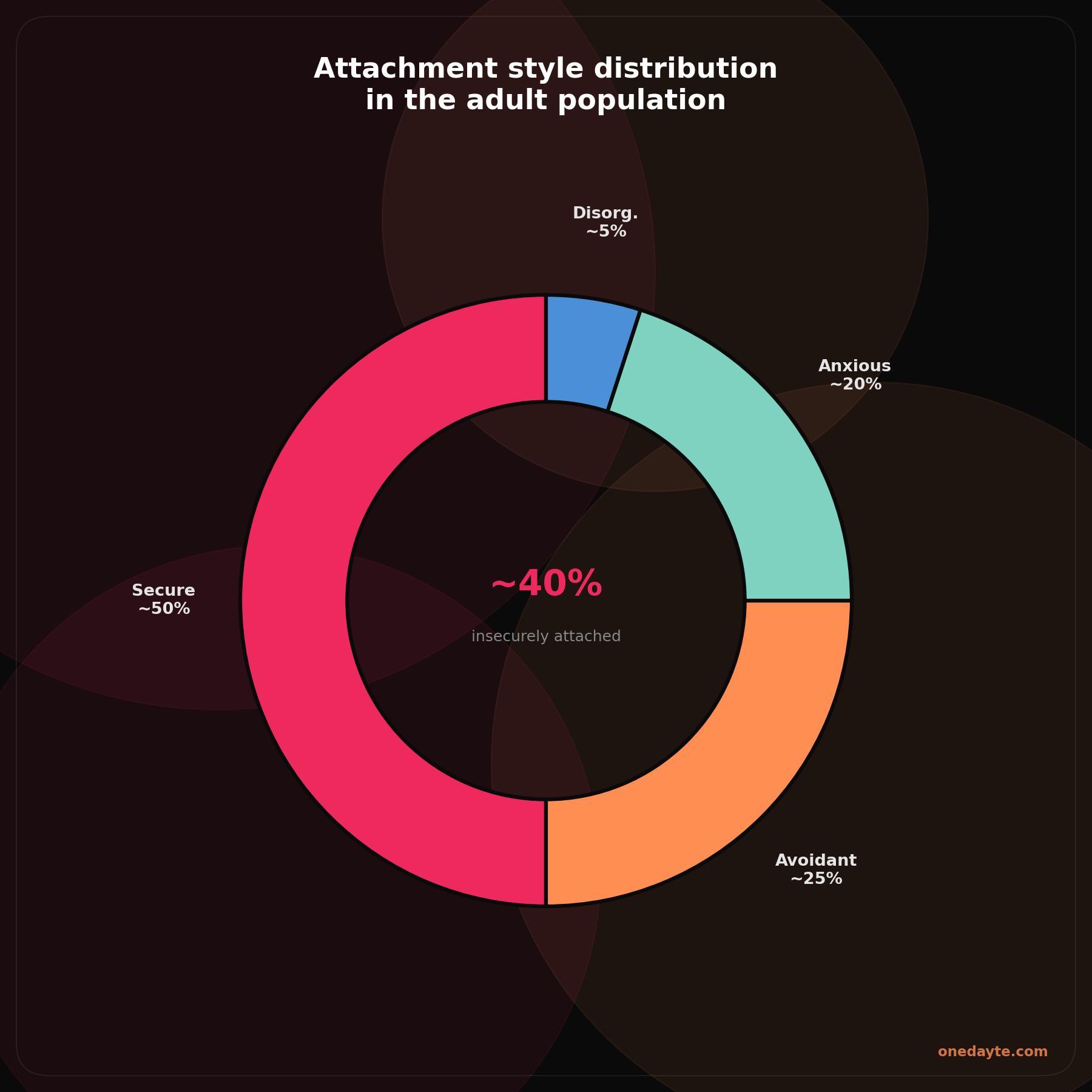
Securely attached (approximately 56 per cent)
You feel comfortable with both intimacy and independence. You trust that your partner is there for you. You communicate openly about your needs and boundaries. You can ask for support and offer support. Conflict doesn't frighten you, because you trust that you'll work it out together. In the dating world, you recognise securely attached people by their calm approach: they are interested but not desperate, engaged but not suffocating.
Anxiously attached (approximately 20 per cent)
You crave closeness but fear abandonment. You need a lot of reassurance from your partner. You worry about the relationship, analyse messages for hidden meanings, and become restless when your partner takes some distance. Your attachment behaviour intensifies when you feel unsafe: more texting, more calling, more confronting. Psychologists call this protest behaviour: behaviour intended to recapture the attention of your attachment figure.
Avoidantly attached (approximately 25 per cent)
You value independence above all else. Intimacy feels suffocating. You withdraw when it gets emotionally too close. You downplay emotional needs, both your own and your partner's. Psychologists call the protective mechanisms you deploy deactivating strategies: idealising an ex, finding faults in the current partner, retreating into work or hobbies as soon as the relationship becomes serious.
Fearful-avoidant (approximately 5 per cent)
A combination of high anxiety and high avoidance. You want closeness but are simultaneously afraid of it. You oscillate between attracting and pushing away, often without understanding why. This is the most complex attachment style and often stems from unpredictable or traumatic childhood experiences. Bartholomew and Horowitz described this style in their influential research from 1991.
Which styles suit each other?
The most stable combination is secure with secure. But a securely attached partner combined with an insecurely attached partner can also work excellently, because the secure partner has a regulating effect. Research from the Fraley Lab confirms that the presence of at least one securely attached partner significantly increases the chance of a stable relationship.
The riskiest combination is anxious with avoidant. These two styles reinforce each other's insecure patterns and create the pursuer-distancer cycle that erodes relationships from within. Onedayte actively filters out this combination in the matching algorithm.
Source: Bartholomew & Horowitz (1991)