EFT: how Emotionally Focused Therapy transforms relationships
Onedayte Redactie
Expert at Onedayte

When your partner says you never listen, you hear a reproach. You go on the defensive, you list the times you did listen, or you walk away from the conversation. But underneath that reproach lies something else: a call for connection. 'I feel alone and I want you to be there for me.' Uncovering and answering that underlying emotion is the core of Emotionally Focused Therapy.
EFT was developed by psychologist Sue Johnson and is the best-researched form of couples therapy in the world. It is the theoretical foundation upon which Onedayte's Doctor Conversation and Conflict Toolkit are built.
The theory behind EFT
EFT is based on John Bowlby's attachment theory: the conviction that adult romantic relationships fulfil the same fundamental need for secure connection as the bond between child and parent. We are biologically programmed to seek a safe haven in our partner. When that haven is threatened (by conflict, distance or unavailability), our attachment system activates, and we respond with the strategies we learned as children: pursuing or fleeing.
Sue Johnson's breakthrough was the insight that most relationship conflicts are not content-based conflicts. The argument about the dishes is not about the dishes. The argument about the dishes is about the question: are you there for me? Can I count on you? Am I important to you? Those underlying questions are attachment questions. And as long as they remain unanswered, every surface-level conflict will continue to escalate.
The three phases of EFT
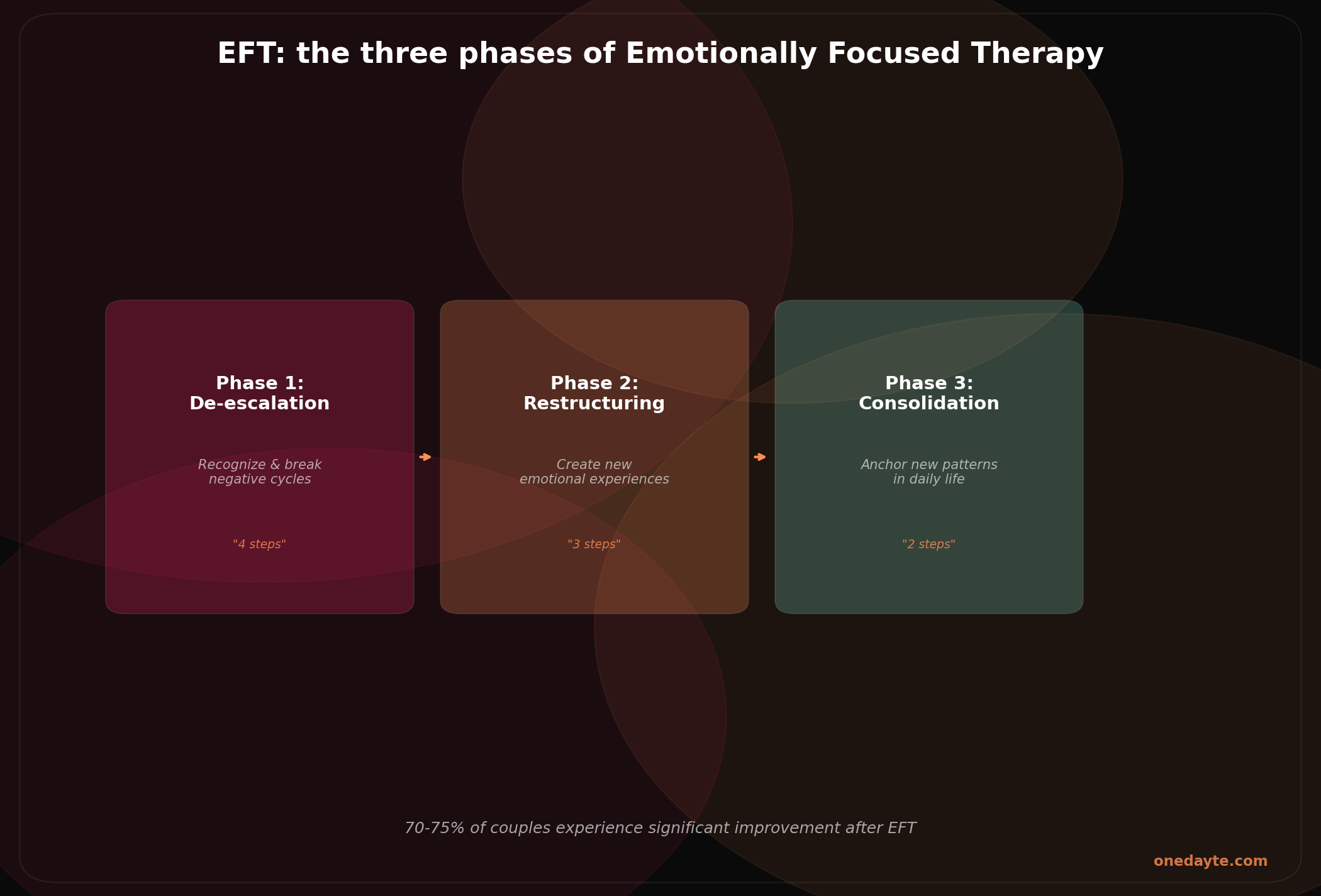
Phase 1 is de-escalation. The couple learns to recognise which cycle holds them captive. The therapist helps both to see that the enemy is not the partner, but the pattern. The pursuer-withdrawer dynamic, the defence-counterattack pattern, the silence-explosion cycle: these are dances that both partners dance unwillingly. By naming the dance instead of blaming the dancer, space is created.
Phase 2 is restructuring. This is the heart of the therapy. Partners learn to express their underlying emotions and needs instead of their protective reactions. The pursuer learns to say: 'I'm afraid I'm going to lose you' instead of 'You never pay attention.' The withdrawer learns to say: 'I feel overwhelmed and don't know how to respond' instead of walking out of the room. That shift from protection to vulnerability is what transforms relationships.
Phase 3 is consolidation. The couple practises the new interaction patterns in daily life and builds a secure emotional foundation. The cycle that held them captive is replaced by a new dance: a dance of openness, responsiveness and connection.
How effective is EFT?
EFT has one of the highest success rates of all forms of couples therapy. Research shows that 70 to 75 percent of couples improve significantly and that this improvement remains stable at follow-up after two years. By comparison: many other forms of couples therapy show relapse over time. EFT does not, because it changes the underlying attachment dynamic rather than merely training surface-level communication patterns.
Johnson's book Hold Me Tight: Seven Conversations for a Lifetime of Love is the most accessible starting point for those who want to learn more. It translates the therapeutic principles into conversations that couples can have on their own.
EFT and Onedayte
Onedayte's Doctor Conversation is designed on EFT principles: from safe to vulnerable, with attention to the underlying emotions behind the words. The questions are not random. They are designed to uncover the same emotional layers that an EFT therapist would explore in a session.
The Conflict Toolkit in Phase 7 uses EFT techniques for repair conversations: self-soothing, the soft startup ('I feel [emotion] when [behaviour] because [need]'), and structured steps to move from protection to vulnerability. It is not a replacement for therapy, but it brings the core principles to the daily life of couples.
Source: Johnson (2004), Emotionally Focused Therapy