Overcoming dating anxiety: scientific tips that actually help
Onedayte Redactie
Expert at Onedayte
Your heart is pounding. Your hands are clammy. You have changed your outfit three times and are considering cancelling. Not because you do not feel like it, but because the anxiety paralyses you. The strange thing is: you want this. You want to meet someone. But your body will not cooperate.
Dating anxiety is one of the most common and least discussed obstacles in the love lives of millions of people. It goes beyond the healthy nerves that everyone feels before a first date. It is a pattern that prevents you from seizing the opportunities you actually want.
What is dating anxiety?
Dating anxiety is the excessive tension and worry you experience around dating situations. It encompasses three variants that often overlap. The first is fear of rejection: the deep conviction that you are not good enough and that the other person will discover this as soon as you show yourself. The second is performance anxiety: the feeling that a date is an exam on which you must score. The third is vulnerability anxiety: the fear of showing yourself as you truly are, including your insecurities and imperfections.
Research by Downey and Feldman, published in the Journal of Personality and Social Psychology, shows that rejection sensitivity is a stable personality trait. People with high rejection sensitivity interpret ambiguous social signals as rejection more readily. A message that is not immediately answered? Rejection. A date who looks at their phone? Rejection. That interpretation reinforces the anxiety, regardless of the other person's actual intention.
"People who anxiously expect rejection tend to perceive it where it does not exist, which in turn leads to behavior that elicits actual rejection."
— Downey & Feldman, Journal of Personality and Social Psychology, 1996
The science behind fear of rejection
Neurological research, summarised by the American Psychological Association, shows that social rejection activates the same brain regions as physical pain. The anterior cingulate cortex, involved in pain processing, responds to an unanswered match in the same way as to a punch in the stomach. That is not a metaphor. It is literally the same pain signal.
That explains why rejection on dating apps feels so disproportionately painful. It is not an exaggerated reaction from an oversensitive person. It is how the human brain is programmed. We are social beings who were evolutionarily dependent on the group for survival. Social exclusion was once literally life-threatening. The fact that this wiring is now activated by an unanswered Tinder match is a mismatch between our primal brain and modern technology.
And dating apps serve rejection at a pace that would be unthinkable in the offline world. Every day dozens of unanswered matches, dead-end conversations, ghosting. For someone with high rejection sensitivity, that is a constant stream of pain signals.
5 evidence-based strategies
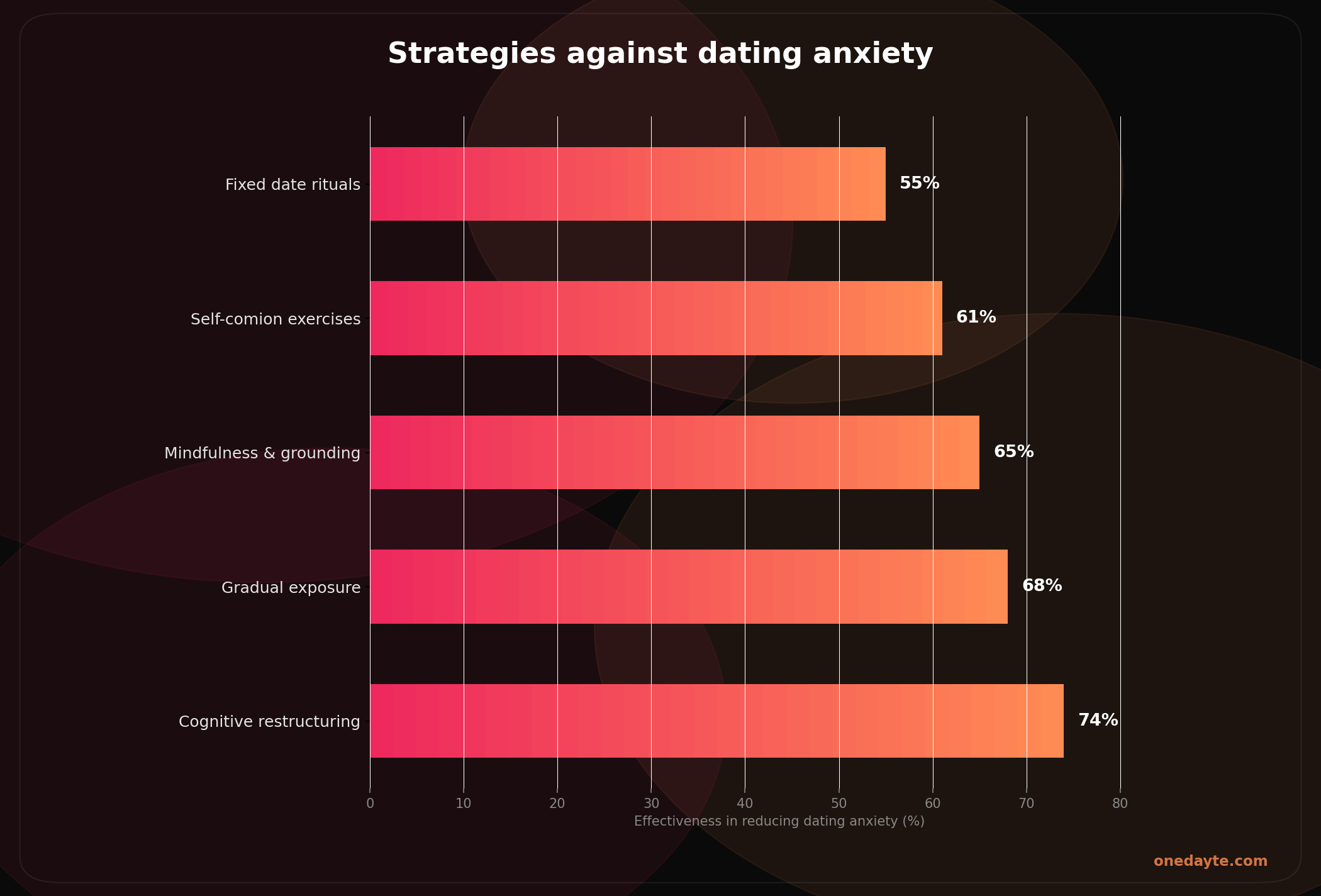
Reframe rejection. A match who does not respond says nothing about your worth as a person. It says something about the fit, or the lack thereof. Sometimes someone is distracted, sometimes the timing is wrong, sometimes there is simply no click. Research on cognitive restructuring shows that consciously reframing the meaning of rejection measurably reduces the emotional impact.
Build up gradually. Start with low-threshold interactions instead of going straight to a dinner for two. A short message, a video call, then a physical meeting. This principle comes from exposure therapy: gradually expanding your comfort zone, with positive experiences as the foundation.
Limit the number of options. Choice overload worsens anxiety. A platform with 3 to 5 quality matches per day is less overwhelming than an app with endless profiles. Fewer choices means less pressure to make the perfect decision.
Talk about it. Normalise your anxiety by discussing it with friends or a professional. Dating anxiety affects an estimated 30 to 50 per cent of all daters. There is nothing wrong with you. It is a pattern you can adjust, not a character flaw.
Focus on curiosity instead of outcome. Approach a date not as a job interview, but as a chance to get to know someone. That shift from 'do I need to perform?' to 'what can I discover?' reduces performance pressure and makes the experience more pleasant for both parties.
How Onedayte reduces dating anxiety
Onedayte's design is deliberately aimed at reducing the factors that fuel dating anxiety. The Guided Connection eliminates the opening-line stress that is the hardest moment for many people. The Progressive Reveal system removes the fear of visual judgement. The limited number of matches reduces choice overload. And the Doctor Conversation prepares you with self-knowledge, the foundation of confidence in dating.
Sources: CBT research, mindfulness meta-analyses