Singles in the United States: facts and figures on online dating
Onedayte Editorial
Expert at Onedayte

How many singles are there actually in the United States? How do they use dating apps? And what do the figures tell us about the state of modern love? This article compiles the most recent data from research, university studies and international reports.
Singles in the United States: the figures
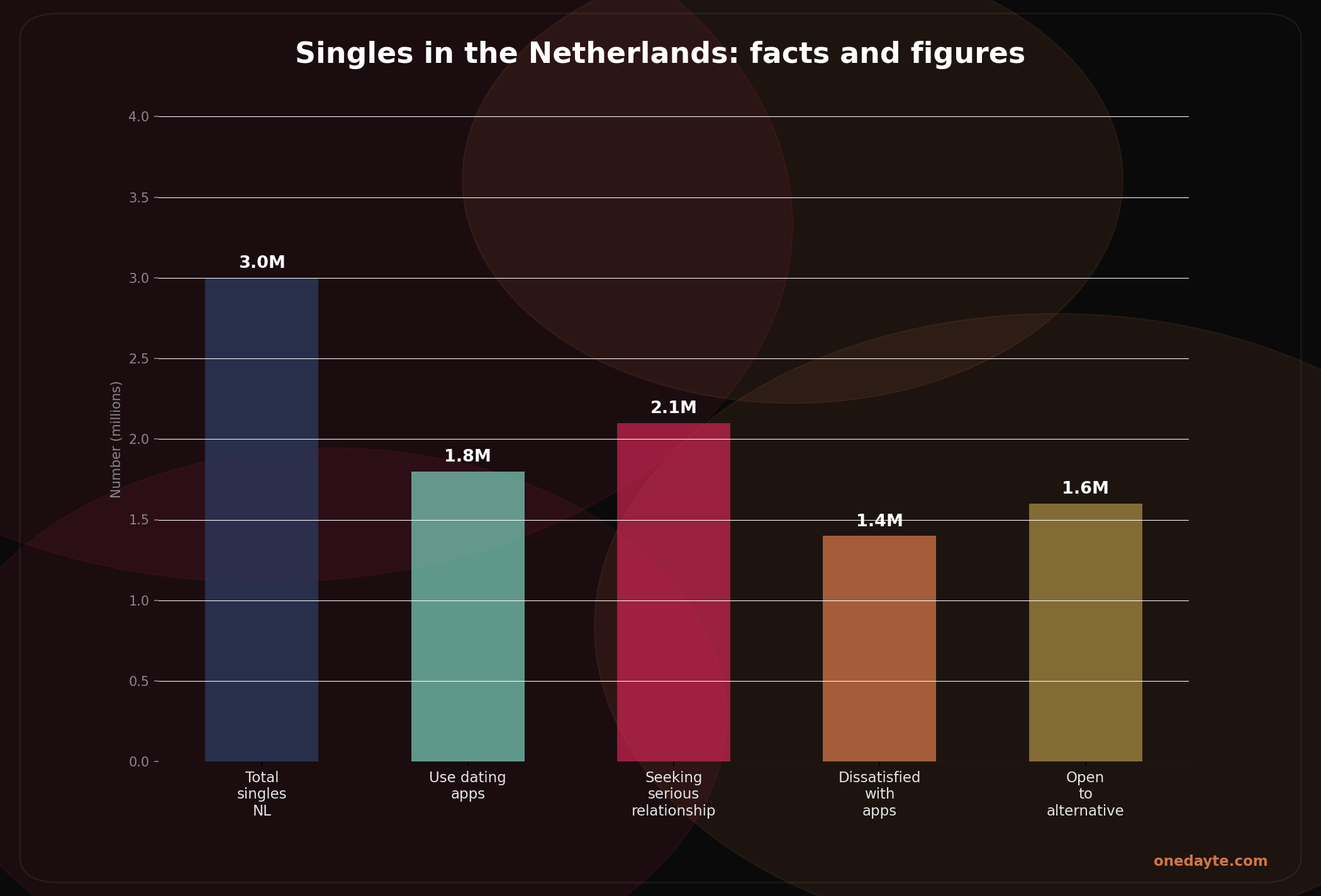
According to the U.S. Census Bureau, the United States has over 37 million single-person households. That is nearly 29 percent of all households. Not all of these people are actively looking for a partner, but it gives an idea of the scale. The growth of single-person households is a trend that has been ongoing for decades, driven by an aging population, later relationship formation and more divorces.
In the 25 to 45 age group — the most active dating population — an estimated 30 to 35 percent are single. That is tens of millions of people who are potentially open to a new relationship. Research by Statista shows that around 60 percent of American singles have used a dating app at some point.
How Americans date online
Tinder is still the most widely used dating app in the United States, followed by Bumble, Hinge and platforms like Match.com and OkCupid. The average user spends 30 to 90 minutes a day on dating apps. Men swipe more broadly (an average of 46 percent to the right), women more selectively (an average of 14 percent).
This asymmetry creates an unequal experience. Women are flooded with matches and messages, leading to choice overload and selectivity. Men receive few matches, leading to frustration and a downward spiral in self-confidence. Both sides experience the system as unsatisfying, albeit for different reasons.
Interesting is the growth of niche platforms. eHarmony and Match.com target higher-educated users. Muzz serves the Muslim community. Grindr the LGBTQ+ community. And an increasing number of apps, including Onedayte, focus on daters who seek depth rather than volume.
What doesn't work: the flip side of the figures
Research by Timmermans and Opree (2019), conducted at Columbia University, shows that 85 percent of American dating app users have been ghosted at some point. 63 percent have ghosted someone themselves. 15 percent of users display addiction-like behavior. And prolonged use is associated with a more negative self-image and increased feelings of loneliness.
A study by MIT confirms that dating apps have an ambiguous effect on users' well-being. They increase the number of encounters but reduce their quality. They give a sense of control but simultaneously create choice overload and FOMO. They promise connection but facilitate superficiality.
The shift towards quality
There is a growing counter-movement. More and more daters are consciously choosing platforms that facilitate depth rather than volume. The term slow dating is gaining popularity. Dating apps that match on personality or attachment style rather than on appearance are growing faster than traditional swipe apps.
This shift fits within a broader societal trend. After years of optimization, efficiency and quantity in all areas of life, the need for mindfulness, depth and quality is growing. In food (slow food), in work (the four-day working week), and now also in dating.
A telling figure illustrates this shift. According to the Dating Burnout Report by Hinge, more than 50 percent of active users experience burnout symptoms. The generation that grew up with Tinder is also the generation most urgently seeking alternatives. They know the downsides from personal experience: the dopamine loops, the ghosting, the choice overload, the declining self-confidence. And they are willing to invest more in an approach that is evidence-based and that actually works.
Another striking figure: according to research by Columbia University, dating app users who have been active for more than a year become less selective in their matches but not happier. They lower their expectations without increasing their satisfaction. That is the opposite of what a dating app should do. A good platform should give you better matches over time, not lower expectations. That insight underscores the need for a fundamentally different model: not more of the same, but better from less.
Sources: U.S. Census Bureau, Statista, research overview