I linguaggi dell'amore spiegati: scopri come dai e ricevi amore
Redazione Onedayte
Esperto di Onedayte

Your partner buys flowers. You would have preferred him to sit on the sofa with you for an hour. You write a long message full of compliments. Your partner would have preferred you to load the dishwasher. The feeling of not being heard is mutual, while you're both doing your best.
Gary Chapman described five ways in which people give and receive love. He called them linguaggi dell'amore. The concept is simple: if you give love in your language but your partner doesn't receive it in theirs, your intention doesn't reach the other person. It's as if you're speaking italiano to someone who only understands French. The message is there, but the reception is not.
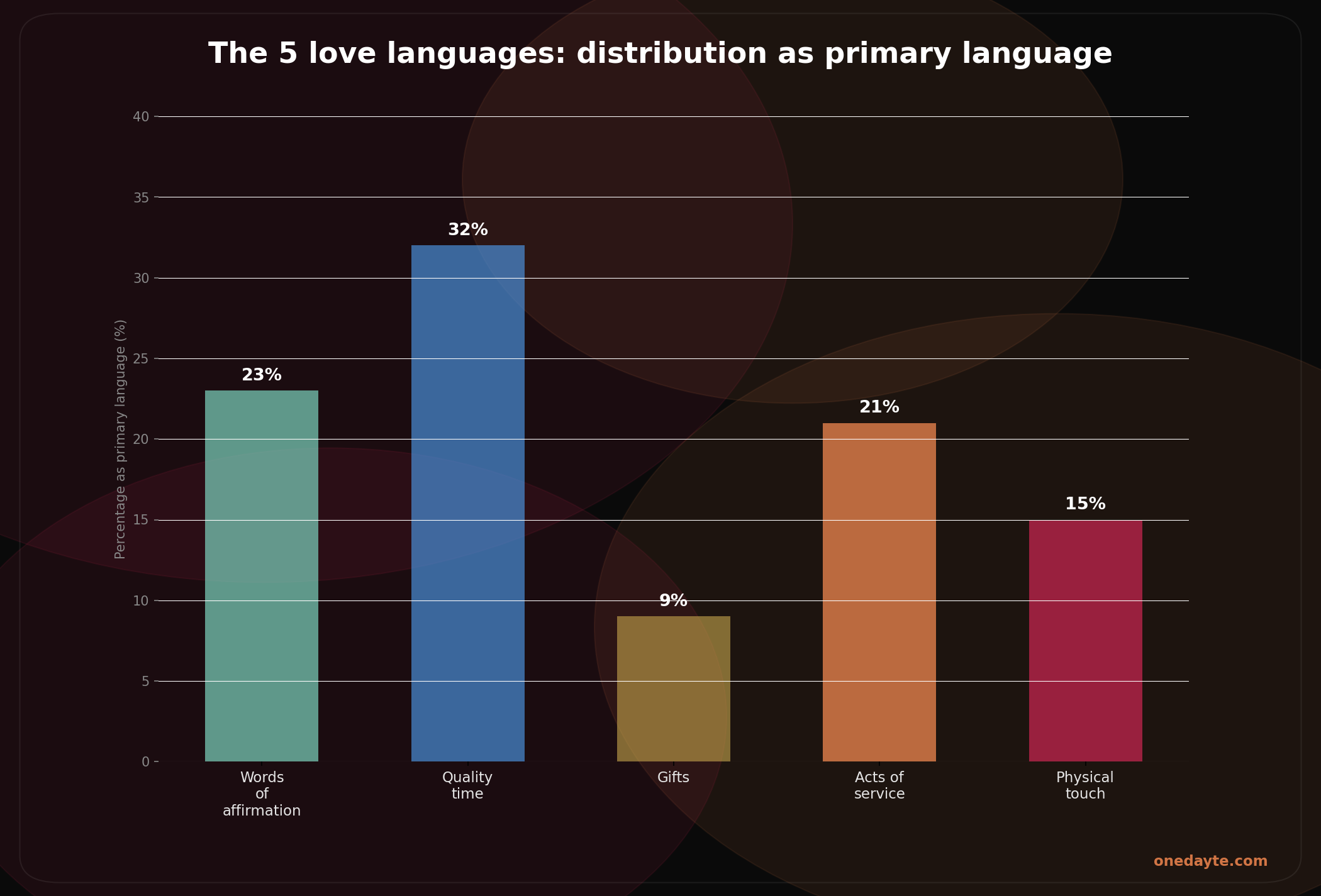
The five linguaggi dell'amore
Words of Affirmation is about words: compliments, encouragement, expressing appreciation, supportive messages. For people with this linguaggio dell'amore, hearing that they are valued is more powerful than any gift.
"We must be willing to learn our spouse's primary linguaggio dell'amore if we are to be effective communicators of love."
— Gary Chapman, The Five Love Languages, 1992
Quality Time is about undivided attention. Being together without distraction: no phone, no television in the background, but truly being present. A walk where you talk. An evening where you cook together. It's not about the activity, but about the attention.
Acts of Service is love through doing. Loading the dishwasher, sorting the shopping, taking the car to the garage. For people with this language, actions speak louder than words. 'I love you' is nice, but making breakfast in bed is proof.
Physical Touch is love through touch. A hand on the back, a hug when coming home, sitting next to each other on the sofa with legs intertwined. For people with this language, physical contact is the most direct route to connection.
Receiving Gifts is not about materialism, but about the gesture: a thoughtful gift that shows you were thinking of the other person. The symbol of the thought counts, not the value of the object.
Why linguaggi dell'amore matter in dating
On a primo appuntamento, someone's linguaggio dell'amore already reveals itself, albeit subtly. The person who compliments you on your outfit probably speaks Words of Affirmation. The person who suggests going for a walk instead of sitting in a restaurant values Quality Time. The person who brings a small gift (a book they wanted to recommend, a chocolate from their favourite shop) communicates through Gifts.
Recognising each other's linguaggio dell'amore early in the dating process prevents a common misunderstanding: the feeling that the other person doesn't give enough, while the other person is indeed giving, just in a different language.
The nuance that is often missing
Chapman's model is popular but has scientific limitations. It has not been validated with the same rigour as teoria dell'attaccamento or Gottman's research. The linguaggi dell'amore describe preferences, not deep relational patterns. They tell you how someone wants to receive love, but not how someone responds to conflict, distance or vulnerability.
That makes linguaggi dell'amore a useful supplement to, but not a replacement for, understanding stile di attaccamento and responsività emotiva. Two people who speak each other's linguaggio dell'amore but have a destructive attachment dynamic won't solve that with more compliments or more quality time. The linguaggio dell'amore is the packaging, the stile di attaccamento is the content.
There is another nuance that Chapman's model misses: linguaggi dell'amore can change under stress. Someone whose primary language is Quality Time may temporarily have a greater need for Words of Affirmation during a period of high work pressure, simply because quality time is not feasible. Flexibility in speaking each other's language is therefore at least as important as knowing it. The strongest couples are not those who speak each other's language perfectly, but those who are willing to adapt to what the other person needs at that moment.
At Onedayte, the linguaggio dell'amore is measured as part of the Conversazione con il Doctor. Not as a quiz with five boxes, but as part of a broader conversation about how you experience and express love. That context makes the measurement richer and more relevant.
Source: Chapman (1992) — The 5 Love Languages