KI i dating: hvordan kunstig intelligens hjelper deg å finne riktig partner
Onedayte Redaksjonen
Ekspert hos Onedayte
AI is changing everything: how we work, how we communicate, how we find information. It was inevitable that it would also change the way we date. But where some apps use AI to keep you sveiping longer (more engagement, more adverts, more revenue), the same technology can be used for something far more valuable: finding a partner who truly suits you.
Spørsmålet is not whether AI will play a role in dating. That role already exists. Spørsmålet is: in whose interest is this technology being deployed?
Hvordan KI brukes i dating-apper i dag
Most dating-apps use AI for two basic functions. The first is optimising the algorithm: which profiles you see, in what order, at what time. This optimisation is aimed at maximum engagement (keeping you in the app as long as possible), not necessarily at finding the best match. Research highlighted by FunX confirms that this revenue model is structurally at odds with the user's interests.
The second function is detecting problematic behaviour: identifying fake profiles, filtering spam, processing reports. Useful, but it does not address the core of what makes dating difficult.
More recently, some apps are experimenting with AI dating coaches that help you with your profile, your conversation skills or your photo selection. Interesting, but it optimises the packaging while the underlying problem (matching on the wrong factors) remains unchanged.
Neste steg: KI for dyp profilering
The truly transformative application of AI in dating is not optimising existing systems, but measuring dimensions that no questionnaire can capture. Research by Tong et al. (2023), publisert i Computers in Human Behavior, describes how AI is able to recognise patterns in communication that even trained therapists do not pick up in real time: defensivitet in word choice, avoidance in response patterns, emotional openness in sentence structure.
Onedayte's Dating Doctor is built on this principle. It is an AI-driven conversation that builds a relational profile in 12 to 15 messages. It measures not only what you say, but how you say it. Do you respond defensively when probed further? Do you withdraw when faced with emotional questions? Or do you respond openly, reflectively and vulnerably? These nuances are data points that no traditional questionnaire can generate.
The Doctor starts safely and gradually builds towards vulnerability, based on principles of reciprocal selvutlevering. The opening is light: 'When you think back to your best period in a forhold, what made it so good?' Spørsmålets become more personal: 'Your partner accuses you of not giving enough attention. Hva er your first reaction?' And finally vulnerable: 'Hva er your biggest pitfall in conflicts?'
Etikken ved KI i dating
AI in dating rightly raises questions about privacy, bias and manipulation. These questions deserve honest answers, not marketing speak.
Privacy: Onedayte's approach is that raw conversations are not stored. Only the extracted traits (tilknytningsprofil, konfliktstil, emosjonell responsivitet) are retained. The user can view which traits have been extracted at any time, adjust them, or delete them entirely.
Bias: every AI system reproduces the biases in the data on which it is trained. Onedayte addresses this with the Anti-Lookism-filteret: of the daily matcher, minst one always falls outside the learned visual preference profile. This prevents the system from reinforcing existing biases.
Manipulation: the line between helping and manipulating is thin. Forskjellen lies in transparency and control. If the user can see what the system measures, can view the scores and can delete the data, it is a tool. If the system operates invisibly to maximise engagement, it is manipulation. Onedayte explicitly chooses the former.
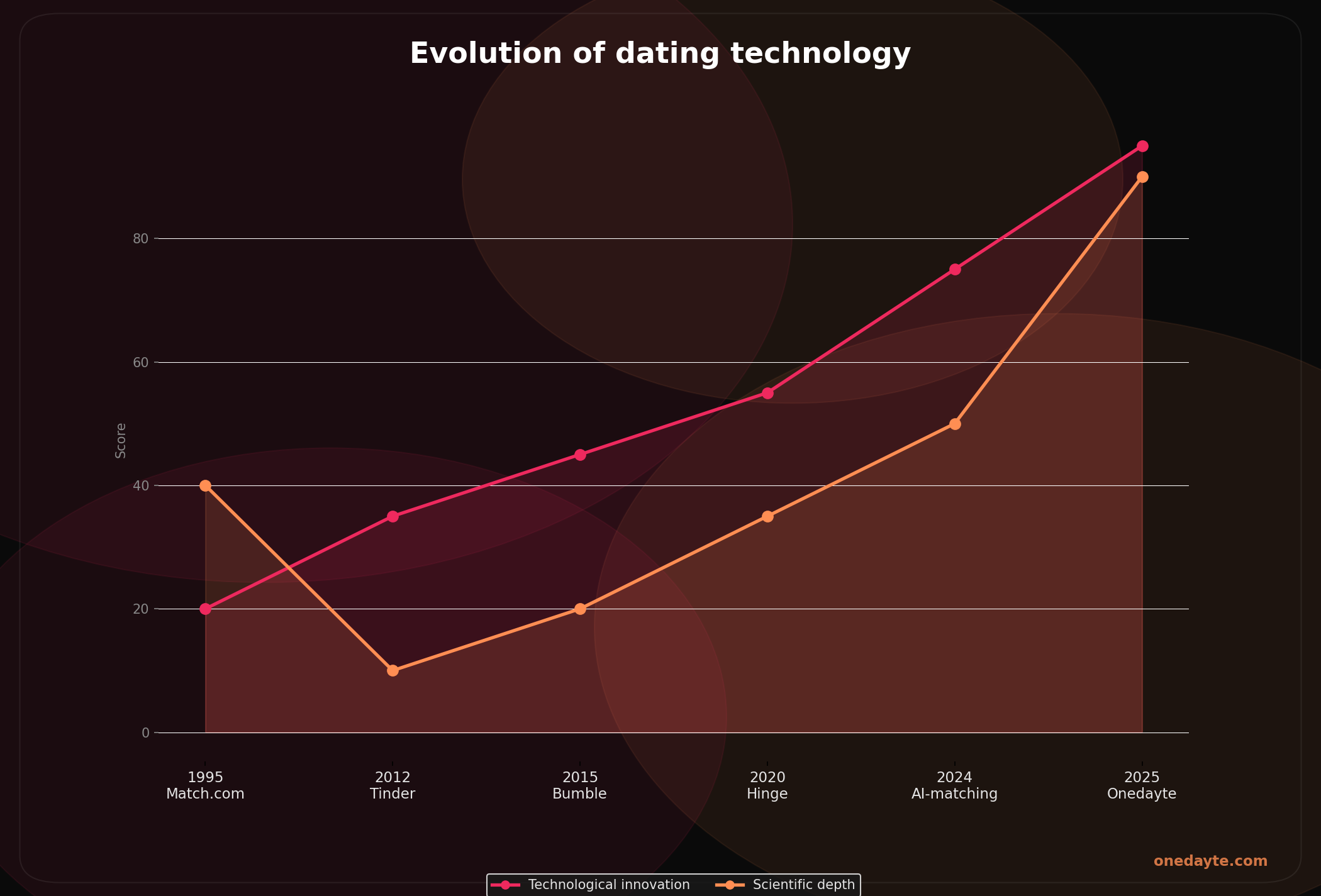
Source: timeline based on platform launches