Situationship: hva er det, hvordan gjenkjenner du det, og hva kan du gjøre?
Onedayte Redaksjonen
Ekspert hos Onedayte

You do everything a par does. Eating together, sleeping together, watching Netflix together on Sunday evening. But when someone asks what you are, an awkward silence follows. 'It's complicated.' 'We'll see where it goes.' 'We don't need a label.' Sound familiar? Then you are probably in a situationship.
The term has exploded on social media and in the everyday vocabulary of daters in recent years. Research into dating behaviour shows that the phenomenon has increased significantly with the rise of dating-apps, which have created a culture in which casualness is the norm and labels are considered scary.
Hva er egentlig et situationship?
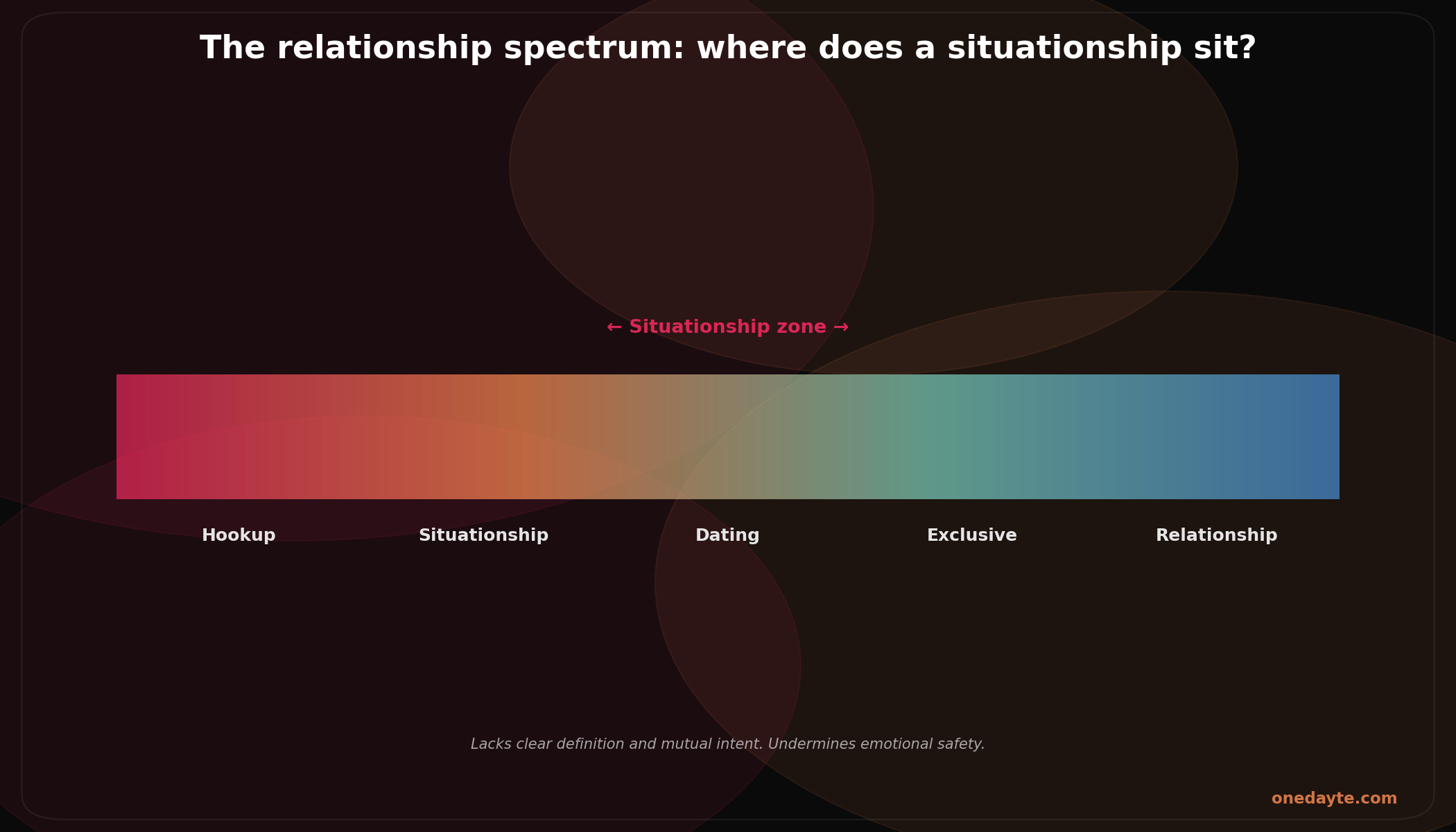
A situationship is a romantic connection that crosses the boundaries of friendship but does not have the status of a forhold. There is no explicit label, no agreement about exclusivity, and no shared expectation about the future. It is more than friends with benefits (feelings are involved), but less than a forhold (no commitment has been expressed).
Forskjellen from the early phase of dating — in which it is logical that there is no label yet — lies in the duration and the avoidance. In a healthy dating process, you gradually move towards clarity. In a situationship, that clarity is actively avoided. The conversation about 'what are we' is postponed, dodged or brushed off with 'let's just keep it fun'.
Hvordan gjenkjenner du et situationship?
You see each other regularly but do not make plans more than a few days ahead. The conversation about the future is avoided by one or both of you. One person is less invested than the other, but this is not spoken about. You feel unsure about your position but do not dare to ask for fear of 'ruining it'. You have not met each other's friends, or you have, but as 'someone I'm seeing'. There is no exclusivity agreement, not even an implicit one.
Hvorfor situationships gjør vondt
A situationship activates the same tilknytningsbehov as a forhold but does not offer the safety that comes with a forhold. You invest emotionally in someone without the certainty that the investment is mutual. This creates a chronic state of uncertainty that is exceptionally taxing on your well-being.
"The bonds of love offer us a safe haven — a shelter from the storms of life."
— Sue Johnson, Hold Me Tight, 2008
For engstelig tilknyttet people, a situationship is a recipe for constant unrest. The uncertainty about the status activates precisely the alarm system that is already on high alert. For unnvikende tilknyttet people, it is actually comfortable — and that is problemet. It offers connection without the confrontation with true intimacy. It is a comfort zone that prevents growth.
Sue Johnson's research into tilknytningsbehov in adult forholds underscores why ambiguity is so painful: people have a fundamental need to know that their partner is there for them. That certainty is not a luxury. It is a basic requirement for emotional well-being. A situationship denies you precisely that certainty.
Hvordan kommer du deg ut av det?
The only way is to have the conversation. Direct, honest, without beating around the bush. 'I want to know what this is for you. What do you want it to become?' Svaret may not be what you want to hear. But it gives you the clarity to make a conscious choice instead of floating in uncertainty for months.
If svaret is that the other person does not want more than what it currently is, then respect your own needs. If you want a forhold and the other person does not, continuing in the situationship is not a compromise. It is short-changing yourself. That is not an easy choice, but it is the choice that brings you closer to what you truly seek.