Vedlikeholde et forhold: vitenskapelige tips fra Gottman
Onedayte Redaksjonen
Ekspert hos Onedayte

Finding a good forhold is step one. Keeping the forhold good is the real challenge. And it's a challenge most par underestimate. John Gottman's research at the University of Washington shows that forholds don't break down due to a big argument or a dramatic event. They die slowly, through neglect of the emotional bond. Like a garden that isn't watered — it doesn't wither in a day but gradually disappears.
Den gode nyheten: science is surprisingly concrete about what works. And it's not grand gestures that make forskjellen, but small daily habits.
Hvorfor forhold trenger vedlikehold
Gottman compares a forhold to an emotional bank account. Every positive interaction (a compliment, a question, a touch, a moment of attention) is a deposit. Every negative interaction (a sneer, an absent look, a forgotten appointment) is a withdrawal. As long as the balance is positive, the forhold can absorb setbacks. But if withdrawals are structurally higher than deposits, the account runs empty. And then even a small incident can make forskjellen between continuing and stopping.
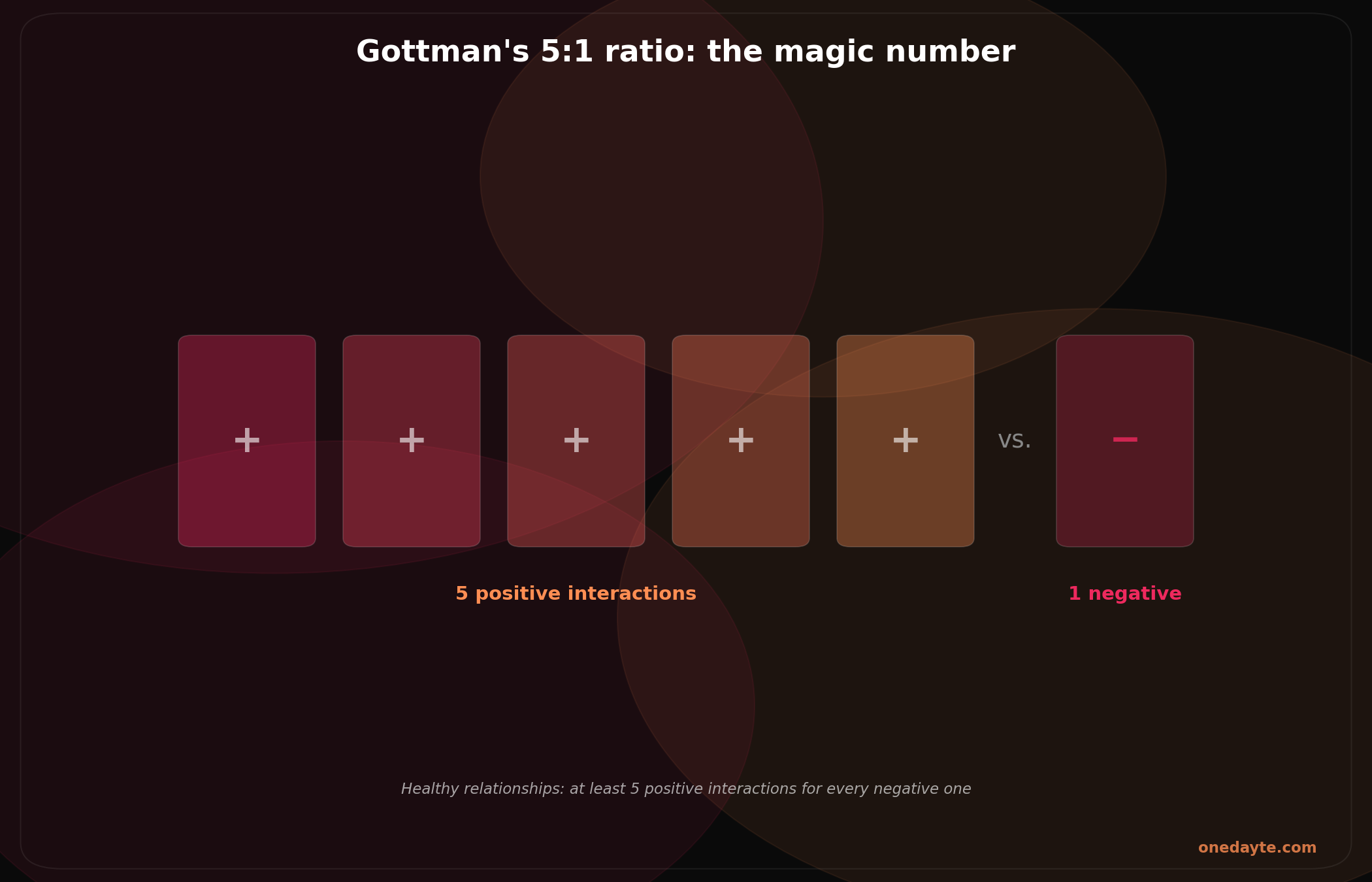
His research among thousands of par produced the famous 5:1 ratio: stable forholds have minst five positive interactions for every negative one. Couples who achieved this ratio he called the masters. Couples who fell below it: the disasters. Viktig nuance: it's not about grand romantic gestures. It's about micro-interactions. Looking up when your partner walks in. Asking how the meeting went. A hand on the shoulder as you sit next to each other on the sofa.
"It's not that these par don't get angry, it's that when they do get angry, they are still able to maintain a sense of humor and affection for each other."
— Gottman & Silver, The Seven Principles for Making Marriage Work, 1999
5 vitenskapelig støttede vaner
"No compelling evidence supports the matching of prospective partners on the basis of similarity."
— Finkel et al., Psychological Science in the Public Interest, 2012
The first habit is updating Love Maps. Do you know what's on your partner's mind right now? Not last month, but now? Couples who regularly ask questions about each other's inner world are more resilient in the face of adversity. Not as an interrogation, but as genuine curiosity. 'What's on your mind?' 'How do you feel about that situation at work?' These are small questions with a big impact.
The second is showing daily appreciation. Fondness and admiration is the second floor of Gottman's Sound Forhold House. It's about actively naming what you appreciate in your partner. 'I appreciate how you handled that situation.' 'I love the way you talk to the children.' Couples who do this regularly have a significantly lower risk of divorce, even when other problems are present.
The third is vende seg mot. Every time your partner says something, sighs, or gives an emotional signal, that's a bid for connection. Do you respond with attention (vende seg mot) or ignore it (vende seg bort)? Gottman oppdaget at par who stayed together turned toward each other in 86 prosent of cases. Couples who divorced did so in only 33 prosent. Forskjellen lies in thousands of small moments per week.
The fourth is planning a weekly bonding moment. Not the standard film on the sofa, but something that connects you. Forskning viser that shared exciting activities increase attraction and forhold satisfaction. Cooking together, walking together, trying something new together.
"Couples who engaged in shared exciting activities reported increases in forhold satisfaction and feelings of attraction."
— Coulter & Malouff, Journal of Marital and Family Therapy, 2013
The fifth is doing a monthly forhold check-in. Ask: how are we really doing? Not as an alarm signal, but as preventive maintenance. What went well this month? Where did we feel distance? What do we need from each other? It's comparable to an MOT test: you don't wait until the engine fails to check whether everything works.
Onedaytes fase 7: relasjonsvedlikehold
Onedayte doesn't stop at the match. In Phase 7, the app offers monthly Forhold Check-ins that gauge the emotional temperature across five dimensions: emosjonell tilgjengelighet, positive interactions, repair ability, appreciation, and felles mening. Additionally, the app sends weekly bonding moment suggestions and provides a Konfliktverktøykassen for when it's needed.
Source: Gottman & Levenson (1992)