A Gottman-módszer magyarázata: 40 év kapcsolattudomány
Onedayte Szerkesztőség
Szakértő az Onedayte-nél

If there is one scientist who comes closest to predicting love, it is John Gottman. Together with his wife Julie, he developed the Gottman Method: a complete approach to relationship therapy and relationship improvement, based on four decades of empirical research involving more than three thousand couples. Not theoretical models built in a study, but conclusions drawn from thousands of hours of filmed interactions in his Love Lab.
The strength of Gottman's work is its specificity. Where most relationship advice remains vague ('communicate better', 'show more respect'), Gottman offers concrete, measurable behaviours that make the difference between relationships that flourish and relationships that fall apart. And those behaviours are surprisingly small.
"Happily married couples aren't smarter, richer, or more psychologically astute than others. But in their day-to-day lives, they have hit upon a dynamic that keeps their negative thoughts and feelings about each other from overwhelming their positive ones."
— Gottman & Silver, The Seven Principles for Making Marriage Work, 1999
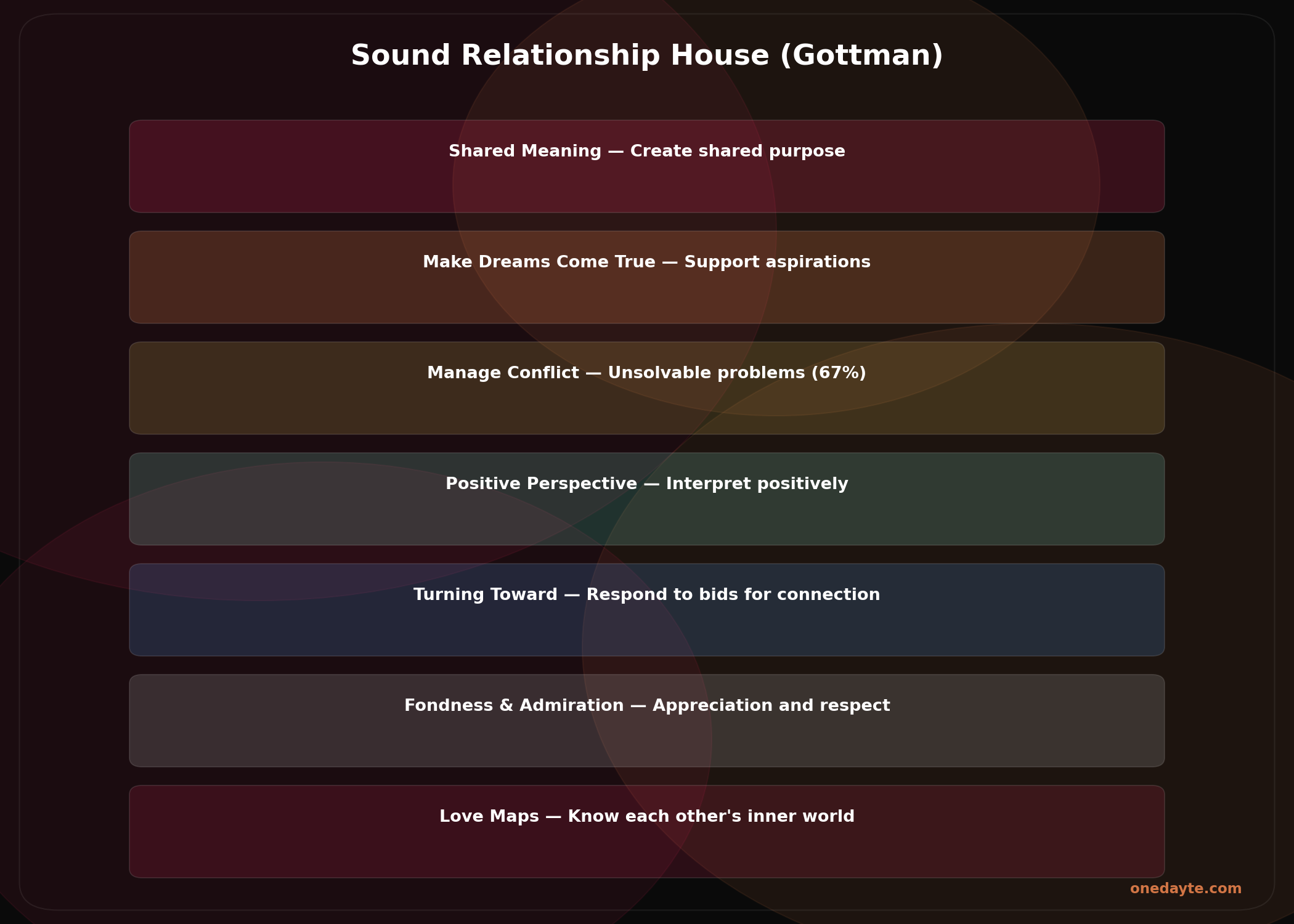
The foundation: the Egészséges Kapcsolat Háza
Gottman visualises a healthy relationship as a house with seven floors, the Egészséges Kapcsolat Háza. It is not a metaphor for fun. It is a hierarchical model in which each floor builds on the previous one. If the foundation wobbles, the rest cannot stand.
The foundation consists of Szerelem-térképek: the detailed cognitive map of each other's inner world. Do you know what preoccupies your partner? Do you know his dreams, her fears, his stressors? Couples who regularly update each other's Szerelem-térképek are demonstrably more resilient in times of adversity.
The second floor is fondness and admiration: actively showing appreciation for your partner. Not as an obligation, but as a conscious focus on what you value rather than what irritates you. Couples who have built a culture of appreciation give each other the benefit of the doubt in ambiguous situations.
The third floor is turning toward: responding to your partner's emotional signals. Every sigh, every comment, every gesture is a bid for connection. Couples who stayed together turned toward each other in 86 per cent of cases. Couples who divorced did so in only 33 per cent. The difference lies in thousands of micro-moments per week.
Above that: positive sentiment override (the benefit of the doubt), constructive conflict management (avoiding the four horsemen), making life dreams come true (supporting each other's dreams) and the roof: shared meaning, the shared life story that you write together.
The 5:1 ratio
One of Gottman's most cited discoveries is deceptively simple: stable relationships have a ratio of at least five positive interactions for every negative one. Couples who achieved this ratio he called the masters. Couples who fell below it: the disasters.
It's not about grand romantic gestures. It's about daily micro-interactions. A smile when your partner walks in. A question about the meeting. A hand on the shoulder. A compliment you speak aloud rather than just think. Each of those moments is a small weight on the scale. And the scale needs to stay positive, every day.
The implication is hopeful. You don't need a perfect relationship. You're allowed to argue (67 per cent of conflicts are unsolvable anyway). You're allowed to make mistakes. But the positive interactions must far outweigh the negative ones. And that is something you can consciously work on, every single day.
The four horsemen and their antidotes
Gottman identified four communication patterns that predictably undermine relationships with 91 per cent accuracy: criticism (attacking character instead of naming behaviour), contempt (sarcasm, eye-rolling, condescension), defensiveness (counterattacking instead of taking responsibility) and stonewalling (emotionally shutting down and walking away).
"Contempt is the single greatest predictor of divorce, and it must be banned from relationships."
— John Gottman, What Predicts Divorce?, 1994
For each horseman he described an antidote. Against criticism: the soft start-up (begin with 'I feel' instead of 'you always'). Against contempt: a culture of appreciation (fondness and admiration). Against defensiveness: taking responsibility, even if only for a small part. Against stonewalling: self-soothing (a 20-minute break to let your nervous system calm down, and then coming back).
The Gottman Method and Onedayte
Onedayte has integrated the Gottman Method into multiple phases of the platform. The Doktor Beszélgetés (Phase 3) detects the four horsemen via conflict scenarios. The Irányított Kapcsolódás (Phase 6) is built on the Szerelem-térképek concept. The Konfliktus Eszköztár (Phase 7) uses Gottman's repair attempts and soft start-up protocols. And the monthly Kapcsolati Áttekintés measures the 5:1 ratio and the turning toward frequency.
Forrás: Gottman & Silver, The Seven Principles for Making Marriage Work