Dating scientifico: come funziona il matching basato sull'evidenza
Redazione Onedayte
Esperto di Onedayte

What if your dating decisions weren't based on an attractive profile or a smooth opening line, but on 40 years of relationship research? What if every match you received was filtered through the same scientific insights that relationship therapists use to help couples? That is the promise of scientific dating. And it is precisely what Onedayte is built on.
Scientific dating is not a marketing term. It is a methodological approach that sets three requirements: the matching must be based on factors that peer-reviewed research has shown to predict successo relazionale, the measurement methods must be validated, and the results must be transparent to the user.
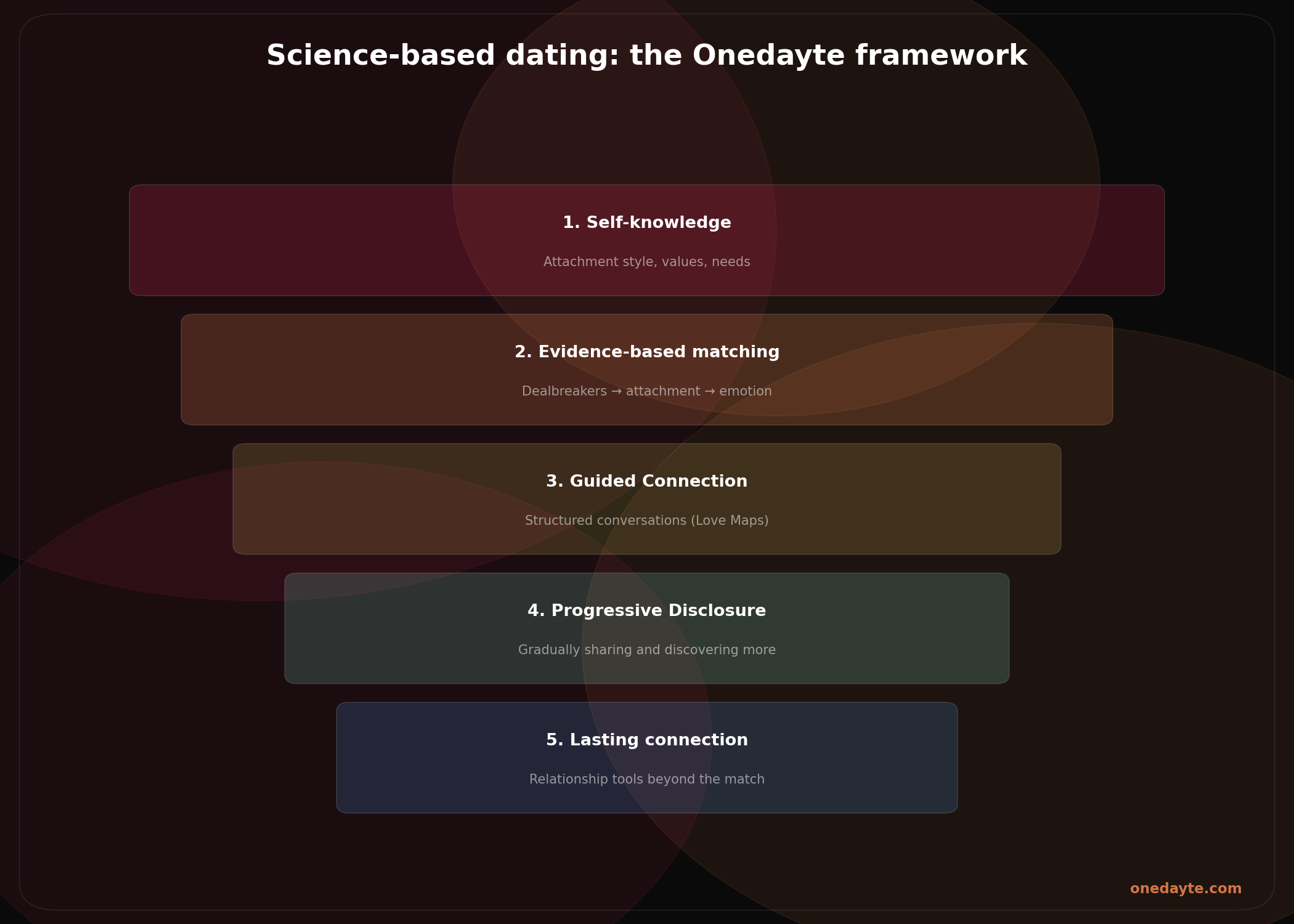
The three pillars of scientific dating
The first pillar is teoria dell'attaccamento. Developed by John Bowlby and Mary Ainsworth, refined by Hazan and Shaver (1987) for adult relationships, and empirically supported by decades of research at the Fraley Lab. Stile di attaccamento predicts how you respond to intimacy, conflict and distance. It determines which partner combinations are stable and which are destructive.
The second pillar is the relationship psychology of John Gottman. Forty years of research among thousands of couples yielded concrete, measurable behaviours that make the difference: the 5:1 ratio, the quattro cavalieri, tentativi di riparazione, Love Maps, turning toward. These behaviours are not subjective. They have been filmed, measured and statistically validated.
The third pillar is the scientific critique of existing dating online, particularly the work of Eli Finkel (2012) and Samantha Joel (2017). Their conclusion is clear: the matching algorithms of existing platforms measure the wrong things. Personality similarity and shared preferences barely predict whether two people will be happy. Cosa predice it: the dynamic between two people.
"The variance in desire was almost entirely a property of the dyad, not a property of the individual."
— Joel et al., Psychological Science, 2017
This insight is confirmed by additional research.
"The matching algorithms that these sites use are not likely to be any more effective than the alternatives that they have replaced."
— Finkel et al., Psychological Science in the Public Interest, 2012
Come Onedayte matches scientifically
The Onedayte process consists of multiple phases that together build a relational profile that goes deeper than any other dating platform.
Phase 1 is the profile: basic information, photos and dealbreaker. Phase 2 is the Scansione dell'Attaccamento: 12 scenario questions that measure your position on the dimensions of anxiety and avoidance. No abstract statements ('I feel comfortable with intimacy'), but concrete situations: 'Your partner hasn't responded to your message. It has now been 3 hours. What do you do?' The answers reveal your actual behaviour, not your self-image.
Phase 3 is the Conversazione con il Doctor: an AI-powered conversation of 12 to 15 messages that measures responsività emotiva, stile di conflitto, repair ability and shared meaning orientation. The conversation progresses from safe to vulnerable, based on EFT principles. The AI analyses not only the content but also the pattern: defensiveness in word choice, avoidance in answer structure, openness in emotional expression.
Phase 4 contains the Match Booster: optional deep-dives such as the Classifica dei Valori (ranking 15 values), a friend reference (5 questions answered by a good friend), conflict scenarios and an external data integration. Each booster adds data points that make the algorithm more precise.
Il risultato is a three-layer matching system. Layer 1 filters on dealbreaker (binary). Layer 2 filters on compatibilità dell'attaccamento (the most destructive combinations are excluded). Layer 3 calculates a weighted compatibility score based on responsività emotiva (22 per cento), stile di conflitto (18 per cento), shared values (15 per cento), fondness and admiration (12 per cento), repair ability (10 per cento) and additional dimensions.
Source: Onedayte evidence-based dating framework