Second date tips: from online match to real connection
Onedayte Redactie
Expert at Onedayte

The first date went well. There was conversation, there was a click, there was a reason to meet again. But the second date feels different. The nerves are still there, but now new questions arise. Was the click real or was it the novelty? How do you move beyond small talk? And how do you prevent the second date from being an anticlimax after a promising start?
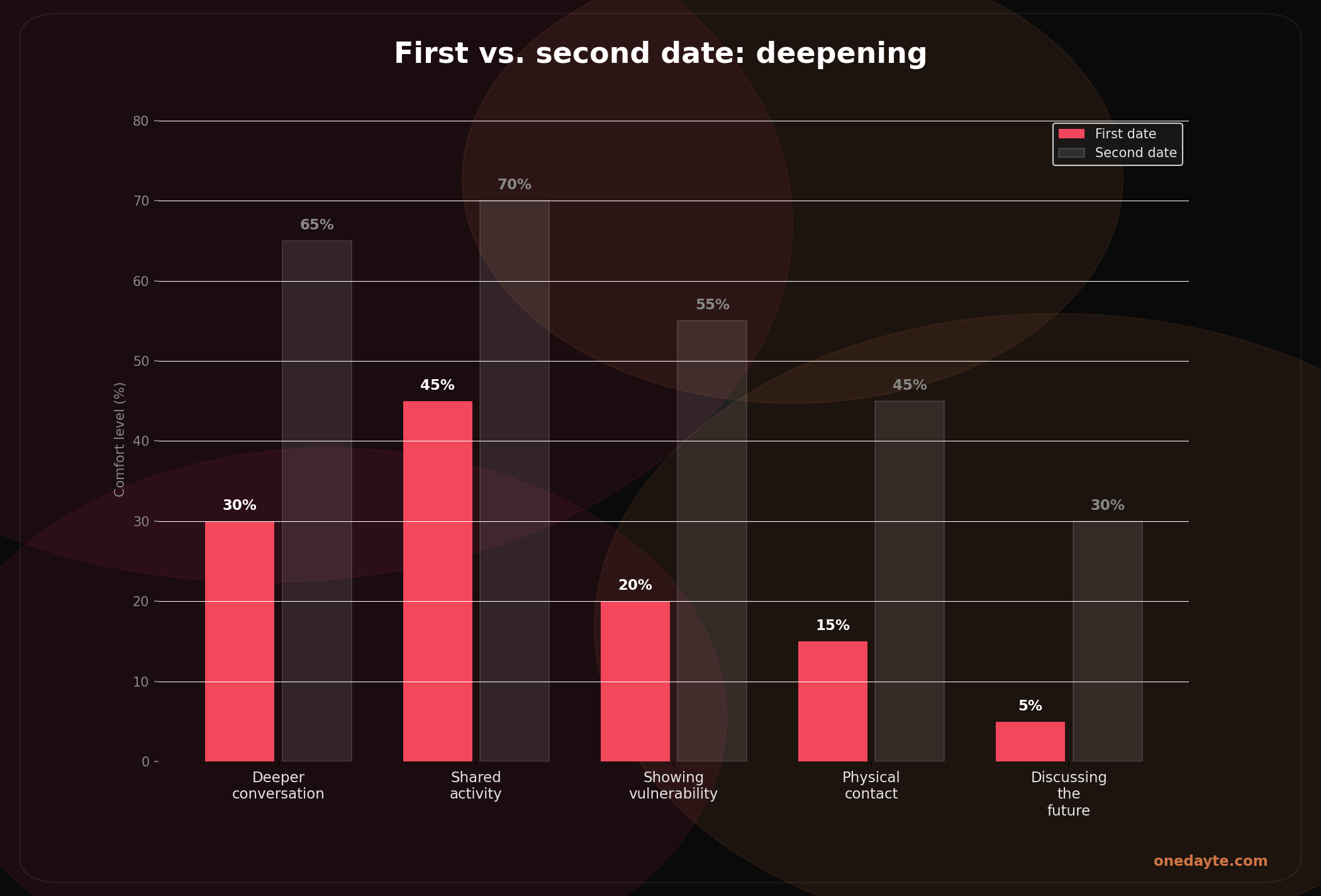
The second date is in many ways more important than the first. The first is about ticking off basic compatibility: does the conversation click, is there any attraction, does it feel safe? The second date is where the real connection begins — or where it turns out that the connection does not extend beyond a superficial first conversation.
Why the second date requires a different approach
On the first date, both parties present their best version. That is human and inevitable. But on the second date, that facade begins to crack — and that is precisely the point. The question shifts from 'Do I like this person?' to 'Can I be myself with this person?'
Research by Eastwick and Hunt (2014), published in the Journal of Personality and Social Psychology, shows that attraction after a first encounter often shifts. Traits that seemed attractive on the first date (humour, self-assurance, appearance) become less important. Traits that only become visible with repetition (warmth, authenticity, emotional availability) become more important. The second date is the moment when that shift begins.
3 evidence-based tips
Do something active together. Research by Coulter and Malouff (2013), published in the Journal of Social and Personal Relationships, shows that shared exciting activities increase attraction and relationship satisfaction. Not a film at the cinema (then you don't talk for two hours), but something that generates energy and stimulates interaction: cooking together, visiting a market, a walk through an unfamiliar neighbourhood, an exhibition.
The explanation lies in misattribution of arousal. The physical arousal generated by the activity (increased heart rate, alertness, energy) is unconsciously partly attributed to the person beside you. Your brain links the arousal to your date, which strengthens the attraction. It is not manipulation. It is creating the conditions in which connection thrives best.
Ask deeper questions. Use Gottman's Love Maps approach: 'What is occupying your mind the most right now?' 'What are you looking forward to this year?' 'What is something you recently learned about yourself?' These are questions that open up the inner world and go beyond the standard questions already asked on the first date. They show that you are genuinely interested in who this person is, not just in whether you are having a nice evening.
Be honest about your nerves. Vulnerability is attractive — Brene Brown's research demonstrated this. 'I'm glad to see you again, but I'm also a bit nervous' creates more connection than pretending you are completely at ease. It breaks through the illusion that everyone except you is relaxed. And it invites the other person to be honest too.
What if the second date is disappointing?
Not every second date delivers the same chemistry as the first. That is normal, and it is not necessarily a bad sign. The excitement of the first time is gone, and what remains is more subtle: a feeling of comfort, of ease, of attentive interest. If that is there, give it a chance, even if it feels less exciting.
Research on the mere exposure effect confirms that attractiveness grows with familiarity. Sometimes a connection needs a third or fourth meeting to blossom. The lesson is: do not judge too quickly. Give it the chance it deserves, unless there are clear red flags or you feel fundamentally uncomfortable.
Some of the most beautiful relationships began with an unremarkable second date that only later blossomed into something special.
Sources: social psychology, Aron (1997)