App di dating basata sulla personalità: funziona davvero?
Redazione Onedayte
Esperto di Onedayte

Boo matches on MBTI. Parship on the Big Five. Hinge lets you fill in personality prompts. And more and more app di dating promise that a personality test will help you find the right partner. The idea is tempting: if we know who you are, we can predict who is right for you. But is that true?
The honest answer is: partially. Personality tests measure something real, but what they measure is not what makes the difference in relationships. And that difference is fundamental.
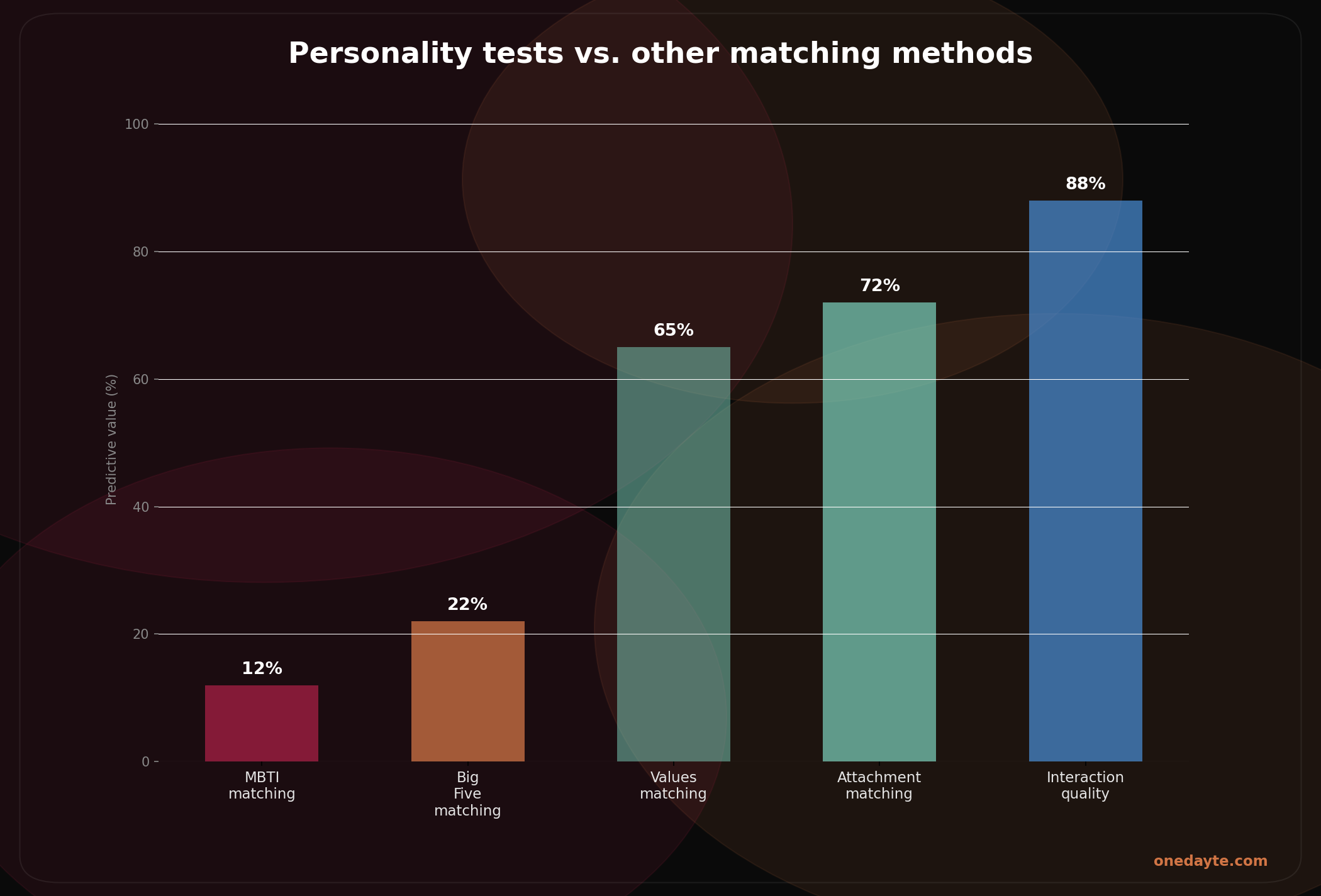
The Big Five model: what it does and doesn't tell us
The Big Five (openness, conscientiousness, extraversion, agreeableness and neuroticism) is the best-validated personality model in psychology. It laid the scientific foundation that has since been confirmed in thousands of studies. There are correlations with soddisfazione relazionale: high agreeableness and low neuroticism are associated with happier relationships. That sounds promising.
Il problema is that these correlations are weak. They explain only a small per centoage of the variation in successo relazionale. Personality traits explained only a fraction of the variation in romantic attraction. Two extraverted people are not automatically a good couple. Two conscientious people aren't either.
"Knowing people's traits, preferences, and values did little to predict who was desired by whom."
— Joel et al., Psychological Science, 2017
The fundamental limitation is that the Big Five describes who you are as an individual, not how you function in interaction with a specific other person. And it is precisely that interaction that determines whether a relationship succeeds.
MBTI: popular but problematic
Myers-Briggs (MBTI) is the personality test you encounter most often on social media. INFJ, ENFP, INTJ: these are labels people love to share and compare. Boo, a app di dating that is becoming increasingly popular in l'Italia, bases its entire matching on MBTI types.
The scientific problem is considerable. MBTI has low test-retest reliability, meaning that when retested after five weeks, about 50 per cento of people receive a different type. An instrument that produces different results upon repetition is not suitable as the basis for a decision as important as who you enter a relationship with. Most psychologists regard MBTI as entertainment, not serious science.
The difference between personality and relational dynamics
Here lies the core of the problem. Personality describes who you are as an individual: how you think, feel and behave in general. Relational dynamics describe how you function in interaction with a specific other person: how you respond to intimacy, how you handle conflict, whether you are emotivamente disponibile when your partner needs you.
Two introverted people can have a wonderful relationship, or one in which both emotionally starve due to lack of initiative. Two extraverted people can build a vibrant social life, or constantly clash because both want to take up the space. It is not personality that makes the difference, but the dynamic that emerges when two personalities meet.
And that dynamic is determined by factors such as stile di attaccamento (how you respond to closeness and distance), responsività emotiva (are you available when the other needs you), stile di conflitto (how do you react when things get difficult) and repair skills (can you move towards each other again after an argument). These are the factors that research identifies as predictive.
Come Onedayte goes beyond personality
Onedayte does not measure personality type. Through the Scansione dell'Attaccamento (12 scenario questions) and the Conversazione con il Doctor (12 to 15 messages with an AI coach), the relational dimensions are mapped that no personality test can capture. Not who you are on paper, but how you function in a relationship. That difference sounds subtle, but it is fundamental.
A concrete example makes it clear. Imagine two introverted, conscientious people are matched based on Big Five similarity. A good match on paper. But in practice, one turns out to be con attaccamento ansioso and the other avoidant. The first constantly seeks reassurance, the second withdraws under that pressure. Their personalities are compatible, but their attachment dynamic is destructive. No personality test in the world could have predicted that. Only an instrument that measures relational dynamics, such as the Scansione dell'Attaccamento, can pick up this difference before it leads to pain.
That is not a theoretical argument. It is the daily reality of millions of daters who are matched based on the wrong criteria and wonder why things keep going wrong.