Stile di attaccamento timoroso-evitante: l'attaccamento più incompreso
Redazione Onedayte
Esperto di Onedayte

You want closeness, but as soon as you get it you panic. You pull someone towards you and then push that same person away. You oscillate between intense longing for connection and an overwhelming need to flee. And the most frustrating part: you don't understand your own behaviour.
This is the fearful-attaccamento evitante style, also known as disorganised attachment. It affects an estimated 5 per cento of adults and is the least understood, most complex of the four stili di attaccamento. Where con attaccamento ansioso people consistently seek connection and con attaccamento evitante people consistently maintain distance, timoroso-evitante attached people oscillate between both extremes.
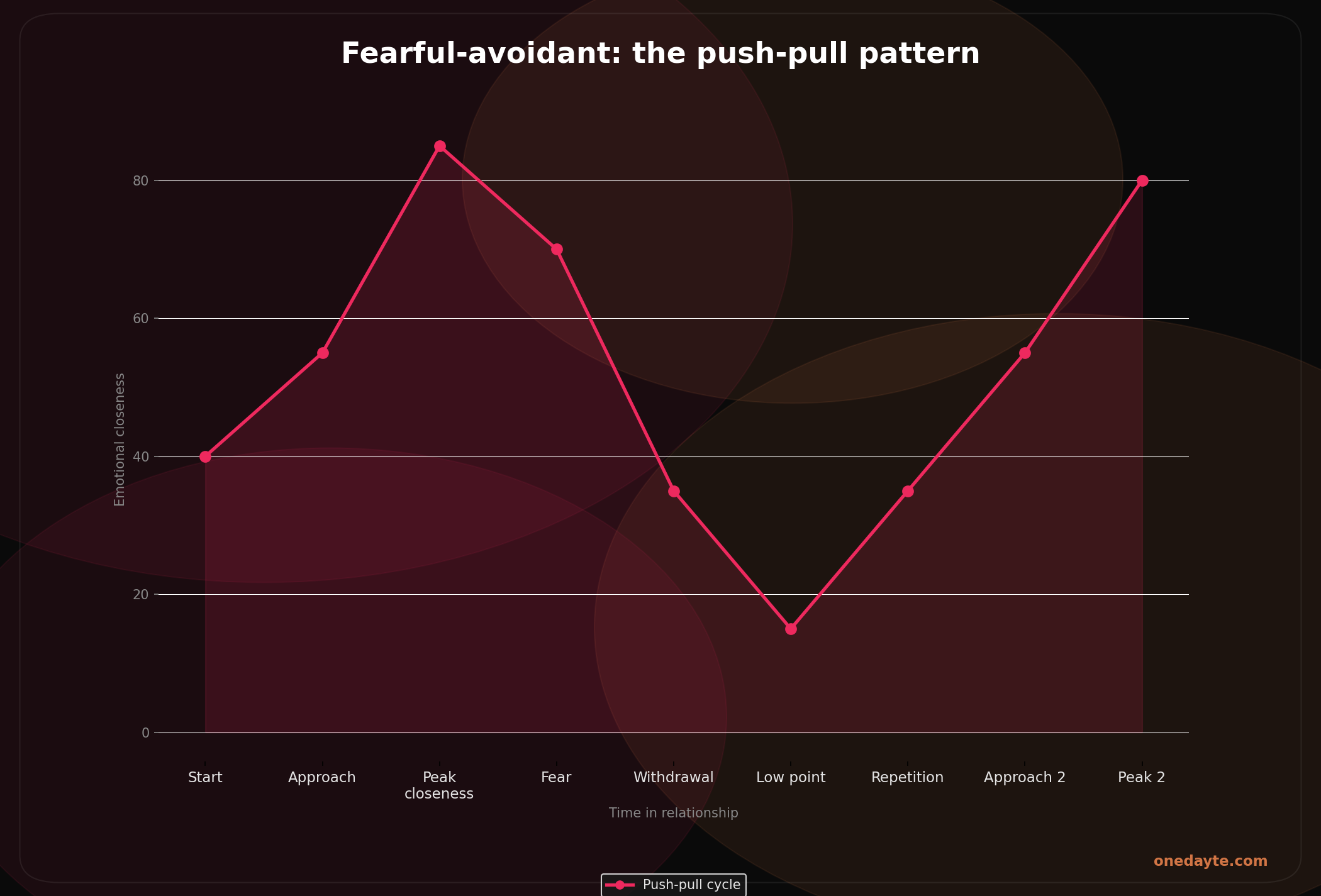
How fearful-attaccamento evitante develops
Bartholomew and Horowitz described in their influential 1991 research (published in the Journal of Personality and Social Psychology) four stili di attaccamento in adults. The timoroso-evitante style combines high anxiety (fear of being abandoned) with high avoidance (discomfort with intimacy). Il risultato is an internal conflict that never fully settles.
This style is often rooted in unpredictable or contradictory childhood experiences. The parent who was supposed to provide comfort was the same person who caused fear. The child learned that the source of safety was simultaneously the source of danger. That creates a double bind: you need the other person but you cannot trust the other person.
In the adult version, this translates to relationships characterised by volatility. One day you are intensely in love and invested, the next day you feel the need to create distance. Not because the partner does something wrong, but because the closeness itself activates the fear.
What it looks like in relationships
The signals are recognisable if you know what to look for. Mixed signals: one day you send twenty messages, the next day you barely respond. Difficulty trusting, even when the partner is consistently reliable. Self-sabotage when the relationship is going well: at the very moment everything feels right, you look for reasons to doubt. Difficulty regulating emotions during conflicts: the reaction is disproportionate to the situation.
Partners of timoroso-evitante attached people often describe it as a roller coaster. One moment they feel like the centre of someone's world, the next moment they feel shut out. That inconsistency is confusing and painful for both parties.
What can you do about it?
Awareness is the first and most important step. Recognise the pattern when it occurs. Do you feel the impulse to withdraw at the very moment everything is going well? That is probably your attachment system, not your intuition.
Seek professional help, preferably Emotionally Focused Therapy (EFT) or schema therapy. Fearful-attaccamento evitante is often rooted in early traumatic experiences that cannot be processed through self-reflection alone. A therapist can help to recognise the double bind and gradually dismantle it.
Choose a partner who is patient, consistent and con attaccamento sicuro. Someone who doesn't take your mixed signals personally but recognises them as attachment behaviour. Someone who stays, even when you push. That is not easy to find, but it is the foundation for recovery.
La buona notizia is that awareness can begin at any age. Couples therapist Michelle Jonker describes on her website how she herself evolved from avoidant in her twenties to con attaccamento sicuro in her thirties. Her experience confirms what the research shows: change is possible, but it requires honesty with yourself and the courage to seek help when your own patterns are getting in the way.
The path to more attaccamento sicuro is longer for timoroso-evitante attached people than for anxiously or con attaccamento evitante people, but the destination is the same: the freedom to love without constantly being afraid that it will hurt you.
It is also important to understand that fearful-attaccamento evitante manifests differently across different life stages. In your twenties, it may express itself as a pattern of intense but short relationships. In your thirties, as a growing fear that you will never find a stable relationship. In your forties, as a weariness with dating rooted in repeated disappointment.